2026 Gallup report: The alarming truth about engagement, wellbeing, and AI


Gallup's State of the Global Workplace 2026 Report focuses on "The Human Side of the AI Revolution" and provides comprehensive insights into employee engagement, wellbeing, and workplace dynamics across the globe.
The 2026 edition finds that global employee engagement fell to 20% in 2025, its lowest level since 2020, costing the world economy an estimated $10 trillion in lost productivity.
This aligns with our Australian and New Zealand research report, The Workplace Engagement Index 2026, which found that 25% of employees say they feel less engaged, while 50% are reporting no change.
Key global themes
 The continuing engagement crisis
Organisations worldwide face an ongoing challenge with employee engagement. This persistent decline affects workplaces across continents and represents a universal concern for business leaders navigating today's complex work environment.
The changing nature of management
The report reveals a significant shift captured in its section on "The Shrinking Perk of Being a Manager", indicating that the traditional advantages of management roles are diminishing globally. This trend suggests that the value proposition of leadership positions is being redefined across different cultural and economic contexts.
Global employee wellbeing
Using a life evaluation scale, the report categorises employees as thriving, struggling, or suffering. The findings are sobering: only 34% of employees globally are thriving, while 56% are struggling and 9% are suffering. This data underscores a worldwide wellbeing crisis that transcends geographic boundaries.
However, the report also found that global employee wellbeing improved for the first time in three years in 2025, offering a cautiously optimistic signal after years of decline.
The emotional dimensions of work
 Globally, 23% of employees experience daily sadness, while 22% report daily loneliness.
A particularly concerning finding is the generational divide: employees under 35 report significantly higher rates of both sadness (28%) and loneliness (26%) compared to older workers.
This pattern appears consistent across regions, suggesting that younger workers face unique challenges in today’s workplace environment.
Transformation through technology
The report examines how AI and technological advancement are fundamentally reshaping work across industries and nations.
This transformation affects workers from manufacturing floors in Asia to service sectors in Europe, from emerging markets to developed economies.
Manager engagement is essential
The most concerning trend in this year’s report? Since 2022, manager engagement has fallen nine points. The biggest single-year dip came between 2024 and 2025, when it slid from 27% to 22%. That erosion matters because managers account for much of the variance in team engagement; when managers struggle, teams follow.
"In short, managers used to enjoy an “engagement premium” at work, but they are increasingly only as engaged as those they lead." - Gallup
In more positive news though, Gallup found that within best-practice organisations, 79% of managers were engaged at work, nearly quadruple the global average.
Gallup stated that these world-class workplaces were spread across all regions and industries, but they had one thing linking them; they prioritised employee engagement as part of their long-term business strategy.
Wellbeing: A small uptick amid elevated strain
Global “thriving” (Gallup’s life evaluation measure) peaked in 2022, declined, and then inched up in 2025 from 33% to 34%. Half of the world’s regions improved, with Latin America/Caribbean and Europe both rising two points. Yet daily negative emotions; stress, anger, and sadness; remain above pre-2020 levels worldwide. Gallup’s new analyses underscore why the work itself matters: when people enjoy what they do, believe it helps others, and feel they have real choices, wellbeing and engagement both rise.
There’s also a leadership paradox. Leaders report higher engagement (26%) and thriving (43%) than those they lead, yet they are more likely to experience a lot of stress (46%), anger (33%), sadness (34%), and loneliness (31%) day to day. Leadership yields agency and impact... and a heavier emotional load. Organisations that want sustainable performance must design support systems not only for frontline teams but also for the leaders supporting these teams.
AI workplace transformation: What Gallup’s 2026 data shows
While the AI findings below come from predominantly US-based surveys in Gallup’s research, they illuminate patterns that Australian and New Zealand leaders should prepare for as AI adoption inevitably scales.
Gallup has observed that AI is boosting individual productivity, but many organisations haven’t unlocked system-level gains yet:
"Among US workers in organisations that have implemented AI, 65% say that AI has had a “somewhat” or “extremely” positive impact on their individual productivity (7% say “somewhat” or “extremely” negative). At the same time, only 12% strongly agree that AI has transformed how work gets done in their organisation." - Gallup
 Leaders report the same macro-micro disconnect. An NBER survey across the US, UK, Germany, and Australia found 89% of executives saw no impact from AI on company labor productivity over the past three years, though they expect a 1.4% boost over the next three.
So, why does this gap matters for engagement? Gallup suggests you can view engagement as “readiness for change.”
AI’s payoff depends on everyday AI use by individual workers; disengagement will dilute those gains, and active disengagement can create real security risks.
Managers are the force multiplier for meaningful AI adoption
Two factors stand out as the top drivers of frequent AI use: tight integration with existing systems and manager-led adoption. Frequent use is far higher when employees strongly agree AI integrates with their work systems (86% vs. 52% who don't strongly agree) and when managers actively support AI use (79% vs. 46% who don't strongly agree).
Manager advocacy really shapes the perceived value of AI use. In AI-investing organisations, employees who strongly agree their manager actively supports AI are:
-
8.7 times as likely to strongly agree that AI has transformed how work gets done in their organisation
-
7.4 times as likely to strongly agree AI gives them more opportunities to do what they do best every day
Unfortunately, the support gap is real. Less than one-third of US employees in AI-implementing organisations strongly agree their manager actively supports AI use; a Gallup study in Germany found only 21% say the same. One major upside? AI could help close management capability gaps.
"Effective people management is a skill. But few managers have natural management talent, and many have not received the training they need to successfully coach teams and individuals toward high performance. AI tools have the potential to provide real-time, personalised manager advice grounded in the best management science. Such capabilities could be a game-changer for the world’s workplace." - Gallup
Jobs and workforce shape are shifting, not necessarily for the worse
Job-loss concern is rising: 18% of US employees say it’s somewhat or very likely their job will be eliminated in the next five years due to automations or AI; that climbs to 23% in organisations implementing AI. This concern is much higher in the finance (32%), insurance (32%), and technology (31%) industries. In Germany, 19% report similar concern where AI is in use.
Headcount effects are mixed and size-dependent. In US organisations implementing AI, large employers (10,000+ employees) are more likely to be reducing workforce (33%) than expanding (30%). Smaller employers (5,000–10,000) are more likely to be expanding (38%) than reducing (23%). AI is reconfiguring workforces in both directions, rather than uniformly eliminating jobs.
Strategic implications
This 2026 Gallup report serves as an essential resource for understanding universal workplace challenges during the AI revolution. The data reveals that despite cultural, economic, and geographic differences, organisations worldwide share common struggles with engagement, wellbeing, and the emotional dimensions of work.
For leaders managing diverse teams or operating across borders, these insights provide a foundation for developing strategies that address the human side of technological transformation on a truly global scale.
What our Workplace Engagement Index shows and what leaders should do next
With the context that Gallup is giving us it becomes all the more important that we look for ways to help the real humans that work with and for us.
Our Workplace Engagement Index 2026 echoes Gallup’s insights; speaking to the emotional dimensions of work, the role joy plays in key performance metrics, the power of recognition, and the disconnects between leaders and employees: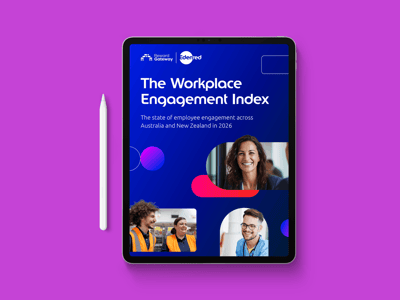
- 46% of decision makers think employee engagement has increased, but only 25% of employees say they’re more engaged
- 57% of decision makers think employees frequently feel recognised, but only one third of employees say they do
- Almost half (47%) of employees who are less engaged cite a lack of joy at work as a key reason (soaring to 76% for deskless employees)
- 56% of employees have considered leaving their job in the last six months
- Around nine out of ten of employees say feeling joy at work improves productivity, connection, retention, purpose and engagement
This is also echoed in recent research by BCG consultants, recently featured in Harvard Business Review, which found that joy at work improved motivation, retention, and sales performance in retail environments:
"Employee joy at work is a performance engine. Employees who reported the highest levels of joy were dramatically more motivated and far less likely to be looking for another job. This is critical in retail environments where turnover can top 60% a year. Employees who enjoyed their work had sales per hour 25% higher across multiple years. Stores with more high-joy employees also delivered better customer experience, reflected in higher NPS and CSAT scores. Joy, it turned out, had fingerprints all over the outcomes leaders cared most about." - BCG
So, how can you drive joy and recognition at work to improve engagement and productivity? Check out this session from our recent RGER Live event: The State of Workplace Engagement in 2026: Why Joy Drives Performance.
Learn more about how Reward Gateway | Edenred’s employee engagement solutions can help you boost employee engagement, wellbeing, and happiness in your organisation.