Why employee joy is the most underrated engagement driver

.png?width=1920&height=1080&name=JdV_Edenred-Flex_ES%20(1).png)
Joy at work is often mistaken for recognition or appreciation. But it’s bigger than both. Recognition is a moment. Appreciation is a signal. Joy is the sustained outcome that occurs when people feel valued, supported, and able to do meaningful work, every day.
It’s the emotional backdrop that enables people to bring their best and it’s not a soft cultural concept. Our research cements that joy is a measurable economic force.
The joy gap is real... and costly
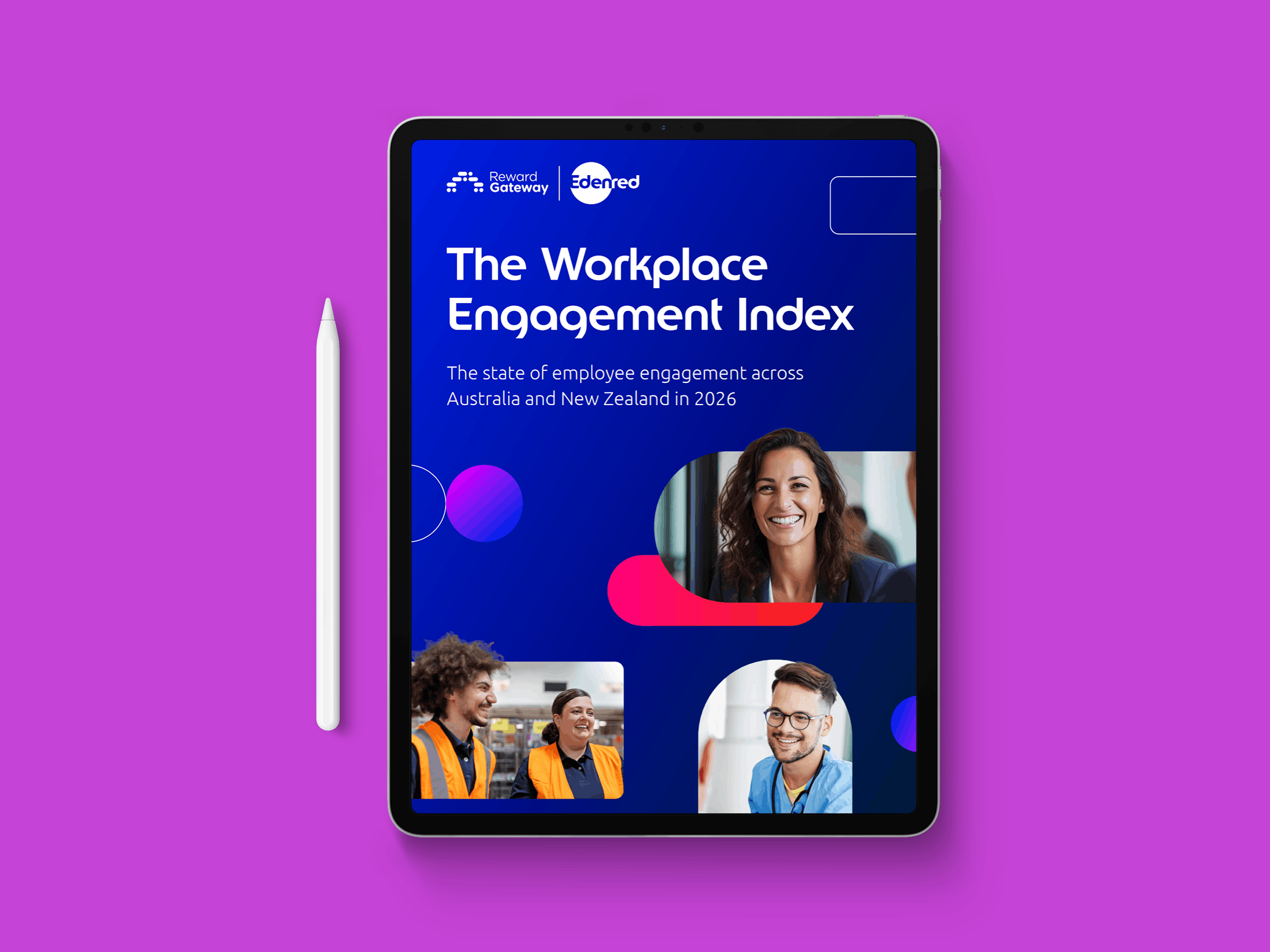
Our 2026 Workplace Engagement Index paints a sobering picture: only 41% of Australian and New Zealand employees say they frequently feel joyful at work. Meanwhile, 60% of HR and business decision makers believe their people frequently feel joyful. That 19-point perception gap shows just how misunderstood, and under-engineered, joy can be in the workplace.
Joy isn’t evenly distributed. Feeling joy at work is higher among Gen Z (46%) and Baby Boomers (45%), but drops notably for Older Millennials (30%) and Gen X (37%). By work setting, fully remote (47%), deskless (45%), and office-based (44%) workers report more frequent joy than hybrid (36%) and frontline employees (40%). Those variances suggest different groups face distinct barriers to feeling supported and able to do meaningful work daily.
Why leaders should care: Joy translates to hard outcomes
When employees feel joyful at work, the impact is immediate and material:%201.png?width=600&height=382&name=2025_JdV_eCard_Gotham-02%20(1)%201.png)
-
91% say it makes them feel more productive
-
92% feel more connected to their team
-
91% are more likely to stay in their role
-
91% feel a greater sense of purpose in their work
-
88% feel more emotionally and psychologically supported by their organisation
-
93% feel more engaged, rather than just simply showing up
External evidence echoes this. Economists at the University of Oxford’s Saïd Business School found that happier workers are 13% more productive, even when doing identical work under controlled conditions. Gallup estimates that disengagement drains US$438 billion in lost productivity from the global economy and that only about one in four employees worldwide are engaged at work. In other words, the absence of engagement and joy is not only a human cost—it’s a balance-sheet issue.
Joy’s link to culture and retention is just as strong. MIT Sloan research during the Great Resignation found that a toxic culture was the single strongest predictor of attrition, more powerful than compensation in explaining why people quit. McKinsey’s analysis similarly showed top reasons for leaving included not feeling valued by the organisation or manager and a lack of belonging, conditions that directly undermine joy.
Joy is cultivated, not accidental
Joy at work emerges through everyday experiences, supportive, replicable systems, and intentional leadership. Yet one in five Australian and New Zealand employees say their organisation does not actively enable joy. Perceptions vary significantly: only 10% of Gen Z and 13% of hybrid workers feel this way, compared to 31% of frontline employees and 32% of Baby Boomers. The message for leaders is clear: you can’t assume the same playbook works for every generation or workforce segment.
FREE WORKBOOK: Want to develop a multi-generational approach to employee appreciation? Access our Employee Appreciation Workbook now. 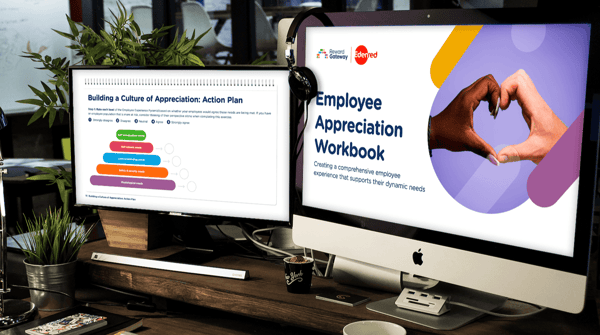
So, what’s actually enabling joy today? When asked how their organisation creates joyful moments, employees point to flexibility in how and where they work (35%), positive company culture (28%), supportive leadership (26%), and good benefits (25%). They also mention social activities or team-building, and growth and learning opportunities (21%).
When asked how their organisation enables joy, decision makers cite a similar list, but put greater emphasis on supportive leadership (46%), positive culture (43%), benefits (40%), growth and learning (38%), and regular recognition from managers (38%).
This recognition gap is telling. Only about one in five employees say their organisation enables joy with recognition from managers or peer-to-peer appreciation, even though decision makers believe it’s already making an impact. For HR and business leaders, this is a significant opportunity, especially given how consistently recognition boosts engagement, productivity, and retention.
What joy at work really looks like in practice
Joy isn’t about perks or performative positivity. It’s the result of meaningful progress, psychological safety, and fair, flexible systems. As Harvard’s Teresa Amabile and Steven Kramer put it, “Of all the things that can boost emotions, motivation, and perceptions during a workday, the single most important is making progress in meaningful work”. Joy flourishes when people can see progress, contribute to something that matters, and feel secure enough to speak up and learn.
A practical playbook to engineer and spread moments of joy:
Make flexible work real
Treat flexibility as a performance system, not a perk, by pairing autonomy over when and where people work with clearly defined outcomes, decision rights, and team norms.
For desk-based roles, set core collaboration windows, document response-time expectations, and protect focus blocks so flexibility doesn’t become always-on.
For frontline and deskless teams, engineer micro-flexibility with predictable schedules, fair shift bidding, easy swaps, and cross-training that makes time-off coverage feasible. Provide the tools to make this work, async workflows, meeting-light days, and quiet hours, and hold leaders accountable for respecting them. Designed well, flexibility becomes an equity engine that adapts to different roles without creating second-class experiences.
Build supportive leadership habits
Train managers to make support visible and consistent through short, frequent 1:1s with clear agendas, rapid removal of blockers, and transparent prioritisation that reduces noise and rework.
Encourage managers to advocate for their teams, shield them from unnecessary scope creep, push back on unrealistic timelines, and secure resources when workloads spike.
Replace generic praise with specific, timely recognition that names the behaviour, the impact, and how it maps to values, using simple frameworks like Action, Value, and Impact (AVI). Model calm under pressure, follow through on commitments, and close the loop when people raise issues so trust compounds. Measure and coach these habits just like any other performance expectation.
Want more advice on developing meaningful recognition that sparks joy? Watch our on-demand webinar: Recognition Best Practices for 2026.
Nurture psychological safety
Create environments where people can speak up, ask naive questions, and admit mistakes without fear of embarrassment or punishment, because that’s where learning and improvement happen. Leaders can model curiosity by asking, “what are we missing?” and responding appreciatively to candour, even when feedback is uncomfortable. Institutionalise “no-blame” retrospectives and incident reviews that focus on process fixes, not personal fault, and highlight examples of intelligent risk-taking that moved the work forward. Use meeting rituals, round-robin input, pre-reads, and “red flag” moments, to widen participation and reduce dominance by a few voices. Recognise and reward the act of raising issues early, not just the act of fixing them late.
Design work for meaning and progress
Help people see the “why” behind the “what” by regularly connecting tasks to customer stories, community impact, or strategic outcomes. Break ambitious goals into visible, achievable milestones and showcase progress with simple tracking of small wins; demo days, burn-down charts, Kanban boards, or “wins of the week.”
Protect momentum by auditing meetings, consolidating status updates, and carving out uninterrupted time for deep work, especially during critical phases. Remove tool friction and unclear handoffs so progress isn’t hostage to avoidable bottlenecks. Celebrate progress as much as perfection, because steady forward motion is one of the most reliable generators of day-to-day joy.
Normalise recognition and peer appreciation
Make recognition a daily habit rather than a quarterly ceremony by building lightweight rituals into the flow of work—weekly shout-outs in team meetings, a dedicated kudos channel, and quick, public eCards that are easy to send.
Train managers to deliver recognition that is specific (what happened), timely (close to the behaviour), equitable (distributed fairly, not just to the loudest), and linked to values and outcomes. Encourage cross-functional appreciation so impact is visible beyond the immediate team and recognition doesn’t depend on proximity. Track recognition patterns to ensure underrepresented voices and less-visible roles are celebrated just as often.
Invest in growth and learning
 Signal belief in people’s futures by offering clear development pathways, skill maps, and access to learning resources that translate into real opportunities.
Build time for growth into the work itself, mentor cohorts, stretch assignments, job rotations, and 10% learning time, so development isn’t something people have to do after hours.
Pay special attention to cohorts reporting lower joy, such as Older Millennials and Gen X, by offering mid-career pivots, advanced mastery tracks, and leadership preparation that goes beyond people management.
Tie learning to recognised milestones (badges, promotions, expanded scope) so progress feels tangible. Celebrate skill gains publicly to reinforce that growth, not just output, is valued.
Strengthen benefits that enable wellbeing
Design benefits that address the whole person, mental health access, financial wellness support, caregiving resources, meaningful paid time off, and options like sabbaticals or recharge days.
Make rest real by planning coverage, smoothing workloads before and after leave, and setting norms that PTO is respected (no guilt, no “stealth” check-ins).
Establish sustainable pacing by balancing demand with capacity, setting realistic deadlines, and clarifying what is truly urgent. Equip managers to spot early signs of overload and intervene with workload rebalancing, prioritisation, or additional resources. Treat wellbeing as a business capability, not a perk, and report on its impact just like any other investment.
Design for connection
Hybrid workers reported lower joy than fully remote or office-based colleagues, so be intentional about when and why people come together so hybrid teams don’t get the worst of both worlds. Use purposeful in-person moments, onboarding, project kickoffs, retrospectives, and milestone celebrations, to build trust faster, and reinforce that connection with strong virtual rituals like asynchronous updates, short stand-ups, and small-group coffees.
Adopt a remote-first approach where everyone joins from wherever they work on their own device, contributions are facilitated equitably, and decisions are captured in shared documents. This means you design and run meetings so remote participants have the same experience and influence as anyone onsite, and a key tactic is having every attendee, even people sitting in the same office, join the video call from their own device with their own camera and microphone.
Why do this:
-
It puts everyone on equal footing: each person is a tile with a name, a camera, and the same ability to speak, react, and use chat.
-
It prevents the “conference room vs. remote” imbalance where in‑room side conversations, body language, and better audio give onsite participants an advantage.
-
It improves facilitation: hand‑raise, chat, polls, live documents, captions, and recordings work the same for everyone.
-
It reduces proximity bias and makes discussion and decisions more inclusive and traceable.
Make work visible, rotate high-visibility opportunities, and evaluate outcomes rather than face time.
Finally, support communities of practice and cross-team guilds so people have multiple avenues to belong, learn, and find energy in their peers. This means you intentionally create and resource employee-led groups where people who share a craft or interest can learn together, improve standards, and build relationships across org boundaries, so individuals have more than just their immediate team as a source of belonging, learning, and motivation.
Measure joy like a business metric
If joy is a measurable economic force, treat it like one. Incorporate a simple joy frequency item into monthly pulse surveys (“I frequently feel joyful at work”), segment results by generation and work mode, and correlate with productivity, retention, and wellbeing metrics. Pair the measure with a few drivers (progress, recognition, psychological safety, flexibility) to identify where to act. Share results transparently, and close the loop by showcasing changes and outcomes.
Closing the perception gap
Right now, many leaders assume their people feel joyful far more often than they do. That perception gap, 60% of decision makers versus 41% of employees, erodes credibility and slows action. Bring employees into the design of joy-enabling systems. Ask teams to identify the top three friction points that sap joy weekly and remove one per sprint. Co-create lightweight experiments (meeting-free blocks, revamped recognition, clearer priorities) and evaluate them publicly.
The payoff is real. Nine in ten HR and business decision makers say they can see that enabling moments of joy at work increases productivity and retention. Joy is the foundation on which recognition and appreciation truly work, and the most underrated engagement driver in modern work.
Joy isn’t fluffy. It’s engineered through systems, stewarded by leaders, and experienced in moments. Build it deliberately. Spread it equitably. Measure it rigorously. And watch performance follow.
If your organisation is seeking to spark joy and drive performance in 2026, chat to one of our employee engagement experts today to see how we can help support you and your workforce.