The secret to solving workplace wellness challenges
Your employees' next wellness coach may be in the conference room next door. See why having a workout buddy can help solve your biggest wellness challenges.


I recently came across the demoralising statistic that only 10% of people stick to their New Year’s Resolutions. We’re just a couple weeks into the new year so hopefully your employees won’t have become part of these numbers yet, but the realistic part of me says that yes, they probably are.
As an employer, you have a unique capability to ensure your team is getting the support needed to still be committed to an exercise program well beyond the regular “quit your gym membership March” that many fall victim to.
Well, when it comes to support, there are few tools out there more effective than having someone there to push you when you hit the gym (or pool, tarmac or grass for that matter, depending how nice the weather is!). Taking up a personal trainer may be the most obvious solution to this, though in spite of the proven benefits when it comes to achieving results, not many people engage with a personal trainer.
But did you know that 80% of the benefits that people say they glean from personal training relate to the motivation they get from their trainer rather than their scientific expertise?
It’s time to encourage your employees to put their wallet away, because the ideal personal trainer may well be sat in the same office as them right now! Despite the plethora of different training methodologies that are available to us today, four out of five people say they exercise because they want to lose weight and/or look nicer. So that means that if you can find at least one person in your office who does regular exercise (31% of the population currently do according to the World Health Organisation) then there's a pretty good chance of being able to find a workout buddy who’s got similar health and fitness goals.
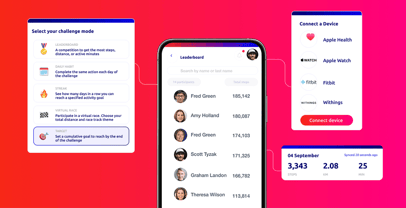
And if you want to go one step further, organisations can support that motivation in a more structured way through goals and challenges. Self-guided personal goals help employees stay focused on the habits they want to build, while team challenges encourage friendly competition, connection, and accountability. Together, they help create habits that stick and a culture that performs.
Guiding your employees toward a unified employee wellbeing strategy can help further develop your employee wellness programs to customise for their needs.

What are the key benefits of having a workout buddy (at work)?
Though many might turn to their (real) next-door neighbour, connecting and encouraging your employees to be workout buddies can be even more beneficial to your employee engagement strategy.
- The majority of exercisers prefer working out with another person (or people): in fact research says that only 10% of people say that they prefer to work out on their own!
- Roughly 80% of people who take up an exercise program abandon it within five months…usually this starts by their skipping the odd workout here and there, with this happening more and more often until missing the workout becomes the norm rather than actually turning up! Once you’ve made a commitment to your workout buddy though, skipping the session becomes a lot harder as it means now letting two people down!
- Even the most committed exercisers benefit from praise and feedback while they’re working out. We’re social animals by nature and not only do we value the company of other people, we’re driven to turn up and train with more gusto when we have the positive reinforcement of other people.
By motivating your coworkers to train together, you’re building bonds and connections outside of the confines of the office. The trust you establish when exercising together, particularly when you’re spotting and motivating each other through the tough times, carries over wonderfully to the office environment: you’ll often find difficult projects you’re working on together will run more smoothly in future.
For employers, there’s also an opportunity to build on that momentum with team-based challenges and organisation-wide leaderboards. Friendly competition can fuel motivation, collaboration, and connection, especially when employees can see progress, celebrate milestones, and work toward a shared goal together. It’s a simple way to turn individual effort into a broader culture of high achievement.

Choosing a workout buddy
As with choosing a personal trainer, it’s critically important that you choose a training buddy you actually like! With the best will in the world, you’ll find yourself making excuses to avoid future workouts with someone who rubs you up the wrong way, even if your fitness goals are perfectly aligned!
Keep in mind that it can also be different strokes for different folks when it comes to how we like to be motivated too. Would you get fired up from being bellowed at by the drill sergeant from “Full Metal Jacket”? A surprising number of us would, though there are many more who would run a mile (albeit in the opposite direction!) from this approach, favouring a much more under-stated motivational style.
Likewise, with your training buddy, your preferred exercise times and availability need to be compatible for this to work. As well as checking each other’s schedules, find out when the other person is at their best for a workout: there are just as many people who can barely summon the energy to switch on the treadmill in the morning as there are who are too tired to train after work.
This is also where flexibility in wellbeing programs matters. Not everyone is motivated by the same activity, schedule, or target. Giving employees the ability to set personal goals around steps, habits, movement, or broader wellbeing behaviours helps make participation feel more relevant and achievable. Features like habit tracking, step counters, custom habits, and wearable device compatibility can help employees pursue goals that fit their own routines and preferences.
And what if you don’t go to the gym?
If the gym isn’t for you, remember it’s not just about gyms any more, and the rise in popularity of outdoor fitness and “inclusive" sports clubs around local parks is further proof of our love of getting our exercise with other people.
An employee benefit that gives your people access to a variety of employee wellbeing choices such as discounted gym memberships, fitness classes, or home exercise equipment could be the right choice.
But supporting employee wellbeing doesn’t have to stop at access alone. Goals and challenges can help employees turn good intentions into consistent action, whether that means building a daily walking habit, taking part in a virtual race, or joining a team challenge with colleagues.
By combining personal goals with collaborative challenges, organisations can support happier, healthier, and more engaged employees while encouraging the positive behaviours that underpin long-term performance.
Want to find out more about implementing an effective employee wellness program that drives engagement and productivity? Chat to our team today.