




 Emily Mellwood

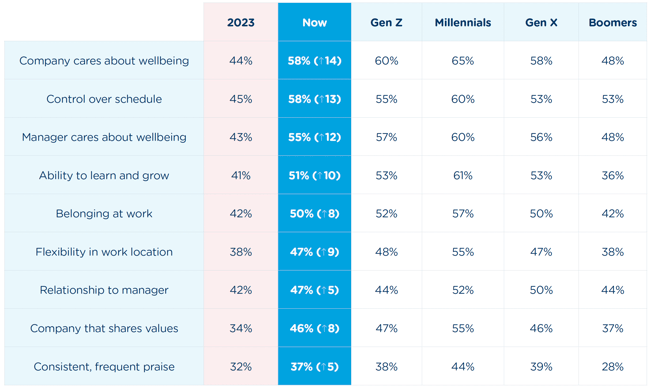
Since 2023, we’ve been asking employees across the U.S. which factors at work are more important than a 10% pay raise. Two years ago, none of the options hit majority agreement at higher than 50%. Today, more than half of these factors are more important to the majority of the workforce than a 10% raise.
Employees are largely in agreement that they want to be able to control their schedule. They want to work for a company and manager that care about their wellbeing. Learning, growing and belonging are not far behind in employees’ demands at work. The good news is that most of these demands cost less than a pay raise.
Manager check-in
Another consistent finding in our report is that manager engagement – and competence – directly affects team engagement.
When managers are firing on all cylinders, problems get resolved quickly, innovation thrives and turnover drops. When managers disengage, customers suffer, employee productivity plummets and business results follow.
Gallup’s most recent report follows the through-line from team engagement all the way to GDP growth. With managers expected to “square the circle” of new demands from both executives and employees, the report warns: “We are starting to see the toll.” Gallup’s checklist focuses on supporting and training managers.
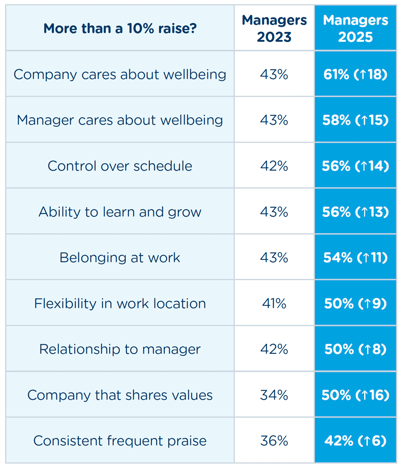
Let’s check in on this population so critical to economic prosperity. If employees are asking for more, managers are caught in the middle. But like employees, managers have increased their focus on the experience an employer can provide, with factors like wellbeing, learning, belonging and control of their schedules growing in importance over a 10% pay raise.
 The manager–employee perception gap
While 66% of managers think they make employees’ lives easier, only 44% of employees agree. Similar gaps show up in:
-
Feeling supported
-
Feeling recognized
-
Having regular one-on-ones
-
Feeling safe sharing wellbeing struggles
Hovering over this disconnect is the fact that 30% of managers are overwhelmed. If companies expect managers to deliver engagement, coaching, communication, performance and wellbeing – they can’t do it without support.
Driving the needs: The decline in wellbeing
Something is driving this increased focus on a better employee experience. It’s not too much of a stretch to link it with the marked upsurge in stress, burnout and loneliness at work.
Why does all of this matter for business outcomes? Because 85% of employees say feeling appreciated impacts their productivity. And 79% say their relationship with their manager impacts productivity.
In other words, culture isn’t “soft stuff” – it’s output. Managers who leverage this insight when deciding how they should allocate their time can make a significant downstream impact on the organization’s success. Supporting employees’ wellbeing through coaching, one-on-ones and recognition can be transformational both to employee experience and to the bottom line.
Learn more about how Reward Gateway | Edenred’s employee experience solutions can help you make your corner of the world a better place to work.
