How to respond to poor employee survey results and build a strong business case


Your latest engagement survey landed with a thud. Scores dipped, the sentiment is sour, and leaders are nervous. But there's no need to hide poor employee survey results... you can use them! Poor survey data is one of the strongest catalysts you have to quantify business risk, focus investment where it matters, and secure budget for real business change. Below, we've pulled together a practical playbook to turn “bad news” into an executive‑ready business case.
Bad survey scores are a gift if you know how to use them
A dip in engagement in your employee surveys isn’t a failure; it’s a precision map. It tells you where disengagement is concentrated, which moments of the employee experience are breaking down, and which populations are most at risk of jumping ship.
The worst reaction is a defensive explanation or an empty promise to “communicate more.” The best response is to translate that poor survey data into dollars, define the root causes, and propose targeted investments with measurable return on investment (ROI).
Translate engagement scores into business risk
Start by linking low engagement to outcomes your executive team already tracks:
-
Regrettable turnover: Are bottom‑quartile teams losing more high performers? How has turnover shifted in the past few months and does this align with where you're seeing poor survey scores?
-
Productivity/quality of work: Are low‑engagement functions missing SLAs or reworking more? What is the quality of work delivered? Have you seen productivity drop in line with engagement data?
-
Customer outcomes: Do low‑scoring frontline teams correlate with lower NPS or CSAT? Are you seeing patterns when it comes to poor engagement scores turning into poor customer experiences?
-
Absenteeism and safety: Are there any trends between poor scores and incident rates or sick days? Have you seen people grow lax when it comes to following procedures and safety guidelines?
You don’t need complex models to begin. Compare top vs. bottom quartiles by team or site over the last 6–12 months and see what patterns emerge.
Example framing: “Teams in the bottom quartile of engagement had 60% higher regrettable turnover and closed 7% fewer tickets per FTE.” A simple heat map that overlays engagement with these outcome metrics quickly surfaces critical hotspots that need your attention.
Quantify the cost of disengagement
Put conservative, CFO‑friendly numbers on these gaps so you can clearly quantify the cost of this disengagement to finance and business leaders:
-
Turnover: Align with Finance on a cost per regrettable departure (could be 0.5–1.5x their salary). If 40 regrettable departures occurred in low‑engagement teams with an average salary of $80k and you use a 0.8x multiplier, that’s ~$2.56M in annual cost to your business.
-
Productivity: If a service team closes 7% fewer tickets per FTE than their peers, translate that into overtime, backlog, or lost revenue. For a 50‑person team at $90k fully loaded, a 7% shortfall equals ~$315k in labour value not converting to output.
-
Absenteeism: If low‑engagement teams average 1.5 extra sick days per year, multiply by daily cost per employee and coverage/OT premiums.
-
Customer impact: Tie lower NPS to churn or reduced upsell likelihood where possible, even if it’s directional.
The output you want is a one‑page “cost of disengagement” table that totals the annualised impact and documents every assumption. Keep it conservative; executives respect restraint more than optimism.
Diagnose root causes with precision, not platitudes
“Communication” and “workload” are too vague to fund. Pinpoint specific, fixable friction points, such as:
-
Manager effectiveness: Low scores on recognition frequency, role clarity, and feedback cadence.
-
Enablement: Deskless employees lacking reliable channels for updates; shift unpredictability; poor access to benefits information.
-
Trust and fairness: Perceived inconsistency in recognition and rewards; weak transparency about decisions and change.
-
Career and growth: Unclear paths, few opportunities to build skills, low internal mobility.
Use cross‑tabs to see which items are dragging overall scores within critical segments (role, tenure, location, manager).
Confirm patterns with comment themes. Aim for three or four root causes, each explicitly tied to a business outcome (e.g. “Lack of specific recognition → higher regrettable turnover in customer support → slower ticket resolution → lower CSAT”).
FREE WORKBOOK: How to Empower Managers to Drive HR Impact
Craft an investment thesis: What to invest in and why now
Translate root causes into a concise investment thesis focused on the biggest cost buckets:
If recognition and manager clarity are low:
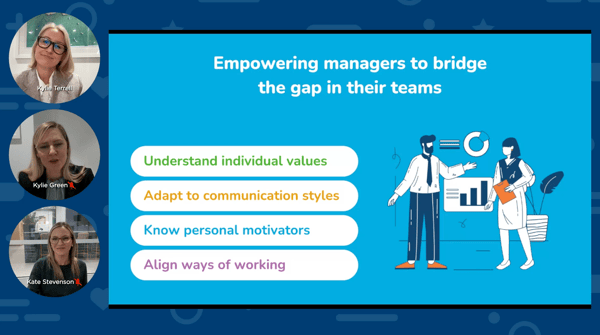 Implement a structured, values‑linked recognition program; equip managers with simple coaching and feedback cadences; provide nudges and templates to make praise specific and frequent.
Want to learn more about empowering your managers to improve employee engagement and performance? Watch our on-demand webinar now.
If enablement gaps are the issue:
Invest in targeted, multi‑channel communications that reliably reach hybrid, remote, frontline, and deskless staff (mobile apps, SMS, on-site posters) and improve shift predictability; make benefits and wellbeing access easier to find and use.
If growth and career development are dipping:
Fund skill development stipends, internal gigs, and transparent role pathways in the functions with the highest regrettable turnover. Show them that your organisation is invested in their long-term development.
Each proposal should specify the target population, how the investment addresses the root cause, and the primary business metric it will move.
Build a simple ROI model executives can trust
You don’t need a PhD in statistics to build an ROI model that leaders will trust, just clear math, conservative assumptions, and sensible ranges. Start by anchoring the model in your baseline “cost of disengagement” from earlier in the analysis. That table is your starting point for quantifying the annualised impact of low engagement on turnover, productivity, absenteeism, and customer outcomes. Using numbers already aligned with Finance keeps the conversation grounded and reduces debates about methodology.
Next, estimate effect sizes for each proposed initiative and present them as low/base/high ranges rather than single-point promises. Where possible, ground these assumptions in internal data or credible benchmarks. For example, a structured recognition program might reduce regrettable turnover in targeted teams by 1–3 percentage points, increase recognition frequency by 10–20 per cent, and lift the survey item “I receive timely recognition” by 3–5 points. These signals show both behavioural adoption and outcome movement, giving executives confidence that the impact is real and measurable.
Similarly, a focused manager enablement program; clarifying expectations, coaching cadence, and feedback quality; may produce a 2–4 point uplift on the survey item “I know what’s expected of me,” alongside a 5–10 per cent reduction in absenteeism. If relevant, include a productivity proxy (such as tickets closed per FTE or units per hour) to connect engagement gains to operational outcomes. Framing all of these effects as ranges helps you manage uncertainty and demonstrate discipline in your assumptions.
Finally, catalog the costs required to deliver each initiative so you can calculate payback and break even. Include software or license fees, enablement and training time for managers, change communications, and any light incentives needed to drive adoption.
Combine these costs with your effect-size ranges to show low/base/high ROI scenarios and expected payback periods. The result is a simple, transparent model that a CFO can review quickly: clear baseline costs, conservative impact estimates, and a line of sight to returns within months, not years.
Example ROI snippet:
Target: 400 employees in customer support with 18% regrettable turnover (72 exits/year).
Investment: Recognition platform + manager coaching + comms ≈ $46k/year.
Effect assumptions: Reduce regrettable turnover by 2–3 points (from 18% to 15–16%): 8–12 fewer exits.
Savings: Using $60k average salary and 0.8x cost of turnover = $48k per exit → $384k–$576k annual savings. Net savings after costs: ~$338k–$530k.
ROI and payback: 8.3x–12.5x return; payback in approximately 1–2 months (assuming savings accrue steadily across the year).
Design the program and measurement plan
Design your program where the pain and potential are highest. Choose one or two segments (e.g. a call centre or a warehouse shift) and define:
Success metrics
Pick 2–3 primary metrics that directly reflect the change you’re driving and set clear, time-bound targets for each (e.g., +3 points on “timely recognition,” −2 pts in regrettable turnover).
Don't forget to include one qualitative indicator (like comments or manager feedback) to contextualise the numbers.
Baselines and comparisons
Use the last 3–6 months of data to establish baselines, and select a comparison group that’s similar in role, size, and schedule to reduce bias.
If a control group isn’t possible, use before/after trends with seasonality adjustments and document any confounding factors.

Timeline
Run your program for a set amount of time (whatever works best for your business and the goals you want to achieve) with a midpoint check and a clear “scale/pivot/sunset” decision gate. Make sure it's long enough to see adoption and leading indicators move, but short enough to keep urgency and focus.
At the midpoint, assess early signals and remove blockers; at the end, apply predefined thresholds to decide whether to scale, refine, or stop. If you're investing in a dedicated platform as part of this initiative, it's a good idea to run a lengthier program to make the most of your investment.
Want to dive deeper? Watch our on-demand webinar: How to Build the Business Case to Launch a Reward & Recognition Program.
Adoption metrics
Treat adoption as leading indicators of outcome; if usage and manager participation don’t clear your thresholds by week 6–8, outcomes won’t follow.
Track communications reach and engagement (opens, clicks, acknowledgments) to ensure the program actually reaches the intended audience.
Governance, risk, and compliance up front
Address key executive concerns before they ask, including:
-
Fairness and bias: Define recognition criteria linked to values and outcomes; run simple equity checks on award distribution by gender, shift/location, and seniority. Set thresholds and an audit cadence (e.g. quarterly reviews) so you can spot patterns early and correct them, and equip managers with clear examples of “what good looks like” to reduce favouritism. If anomalies appear, investigate root causes and adjust criteria or approvals to restore fairness.
-
Privacy and ethics: Aggregate reporting; be transparent about how data is used; obtain necessary permissions. Establish data retention limits and access controls, and conduct privacy impact assessments for new analytics to ensure you only use data that’s necessary. Where possible, offer opt‑in participation and include clear disclosures in your communications; align vendor contracts to these standards.
-
Global/local: Set core principles centrally and adapt communications and recognition mechanics to local norms and regulations. Involve local HR early, translate content, and account for legal or tax differences (e.g. monetary awards vs. non‑cash recognition). Maintain consistency with a global playbook, but empower local champions to tailor examples, channels, and timing so programs stay culturally relevant and compliant.
Tell the story: The one‑slide executive summary
Synthesise the business case so a busy CFO can grasp it in one minute:
The problem: “Low engagement in Support and Ops is driving ~$3.1M in annualised cost across turnover, absenteeism, and productivity.”
The cause: “Three root causes are low recognition, unclear expectations, and poor comms reach for deskless staff.”
The solution: “Two targeted investments; recognition + manager enablement; deskless communications upgrade.”
The ROI: “$338k–$530k net annual savings after costs (based on a ~$46k annual investment); approximately 8–12x ROI with payback in ~1–2 months.”
The plan: “A dedicated program, clear metrics, governance in place.”
Close with momentum and resources
You’re not asking for a blank check. You’re asking to redirect spend toward the most expensive problems exposed by your own data, with a detailed plan to prove value quickly. Commit to transparency: publish program goals, share interim results, and involve managers in co‑designing fixes.
Bad survey results aren't the end of the story; they're the beginning of a better one, if you turn them into a quantified risk, a focused investment thesis, and a program with clear ROI. Build the case with precision and transparency, and you’ll earn both the budget and the trust to deliver real change.
Schedule a demo to learn more about Reward Gateway | Edenred’s suite of employee engagement solutions and find out more about how we can help you make your corner of the world a better place to work.