




%20(1).jpeg) Alexandra Powell
Alexandra Powell

When budgets are being drawn up for employee wellbeing efforts, it might feel like an altruistic expense. “This money is all about making employees happy.” It might seem that employee wellbeing efforts are competing with productivity measures, however McKinsey & Company found that improving employee health and wellbeing has the ability to create $3.7 trillion to $11.7 trillion in economic value – the same as raising global GDP by 4 to 12 percent.
When employees are at their best, so is the work they do and business outcomes benefit. Employees rate their wellbeing as important enough that 58% now say a company that cares about their wellbeing is more important than a 10% pay raise. It makes sense that when employees do feel like the organization supports them, they are less likely to leave, taking their expertise with them.
In this blog, we will break down the relationship between wellbeing and productivity, why they’re both important to teams and the business, and how to achieve balance through practical, people-first strategies.
What is the relationship between employee wellbeing and productivity?
 Holistic employee wellbeing encompasses wide ranges of topics including physical health, mental health, social connections, and financial security. Mental and physical wellbeing’s impact of productivity may seem more intuitive – when people feel well they work with more focus. But financial wellbeing has an impact as well – 38% of U.S. employees say that the current economy is impacting their ability to be productive at work (RGER). Productivity, on the other hand, refers to not just the quality, efficiency, and consistency of work output – but doing better work sustainably over time.
The relationship between these two factors is deeply interconnected and bidirectional. When wellbeing is supported and employee needs are met, productivity is increased. Gallup found that organizations with highly engaged employees – those whose wellbeing needs are met – show 81% less absenteeism, 41% fewer quality defects, and 23% higher profitability.
This works in reverse as well. Productivity pressures can erode wellbeing when not managed carefully. As is likely the case with the one-third (32%) of U.S. employees that report frequently experiencing stress, the 26% feeling overwhelmed, and the 25% of employees that report experiencing burnout. When not taken seriously, pressure on employees can lead to cycle where productivity and wellbeing suffer and neither people or the business win.
Why should organizations prioritize employee wellbeing?
Employee wellbeing isn't a "nice-to-have" perk – it's a strategic business imperative with measurable returns. Organizations that are high performing at designing the employee experience report significantly better business outcomes, including 1.8 times higher workforce productivity and 1.4 times better overall organizational performance. Having organizational and individual strategies to support wellbeing also plays a critical role in preventing burnout and sustaining long-term workforce stability.
Rather than competing with productivity, wellbeing investments fuel it. Organizations that prioritize employee needs are 1.5 times more likely to experience high performance. Considering wellbeing in this light reframes it from altruism and a cost center to a strategic investment in engagement, focus, creativity, and retention.
How can organizations balance employee wellbeing and productivity?
 Balancing wellbeing and productivity requires intentional, evidence-based strategies tailored to your organization's unique culture and workforce needs. Here are six practical approaches:
1. Offer flexible work arrangements
Flexibility has become a cornerstone of modern wellbeing strategies. In fact, 52% of employees say flexible work policies will affect their decision to stay at their organizations. Flexible arrangements – whether remote work, hybrid models, or flexible hours – reduce stress by allowing employees to integrate personal and professional responsibilities more effectively.
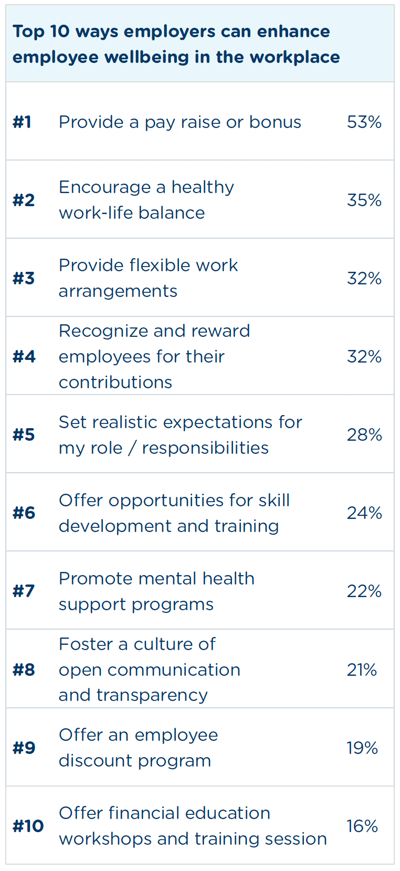
The benefits extend beyond satisfaction: 32% of employees rank flexible work arrangements among the top ways employers can enhance wellbeing in the workplace (RGER). Organizations offering flexibility report benefits including reduced commuting stress, better work-life balance, and access to broader talent pools.
2. Establish clear boundaries and encourage disconnection
One of the top ways employees want managers to enhance their wellbeing is by providing clear goals and expectations (RGER). Establishing boundaries means setting realistic workload expectations and respecting personal time. When employees report that 26% cite "not working long or extra hours" as having the greatest positive impact on work wellbeing, it's clear that stepping away from work actually supports better work in the long-run.
This behavior isn’t just for employees, a lot is expected of managers and so they should model disconnecting from work – turning off notifications, not checking in during vacations, etc., to support their personal wellbeing and to model boundaries at the leadership level.
3. Prioritize mental health and wellbeing resources
Making mental health support available and easily accessible is fundamental. Among employees who rated their employer's mental wellbeing support as excellent or good, only 17% said they frequently experience loneliness at work. However, among those who rated that support as poor, 42% said they frequently experience loneliness.
Managers should be provided training on what benefits exist to help employees find the resources they most need, including Employee Assistance Programs, wellbeing stipends, access to counseling, etc. Managers can also benefit from support on how best to create a culture where it's safe to discuss mental health challenges.
4. Promote regular breaks and sustainable work rhythms
Sustainable productivity requires regular rest and recovery. Time off is particularly valuable – 46% of employees say receiving time off-related benefits makes them much more productive at work. Interestingly, research by Ernst & Young found that for every 10 hours of additional vacation employees took, their year-end performance rating improved by 8%.
Encouraging breaks throughout the day, respecting vacation time, and discouraging always-on culture helps prevent burnout while maintaining consistent performance.
5. Expand financial wellbeing programs
Financial stress directly impacts workplace performance. Financial wellbeing programs – including education workshops, retirement planning support, and employee discount programs – address a critical but often overlooked dimension of wellbeing.
While 16% of employees say offering financial education workshops would enhance their wellbeing (RGER), the impact extends beyond that percentage when financial stress is reduced across the workforce.
6. Recognize and reward contributions meaningfully
Recognition is one of the most powerful and accessible levers for improving both wellbeing and productivity. In fact, 32% of employees say recognizing and rewarding employees for their contributions would enhance workplace wellbeing (RGER). Recognition can also be used by managers to highlight those behaviors that tie to business growth – making its benefits twofold.
Recognition doesn't need to be expensive to be effective. What matters is that it's frequent, authentic, and aligned with individual preferences.
Real-world examples of organizations getting it right
These organizations demonstrate how strategic wellbeing investments drive measurable results:
Ergon Terminaling connects and energizes the workforce
 The Ergon Terminaling management team enhanced their efforts to prioritize employee health and wellbeing both to benefit employees and to ensure the workforce was at its best. The team wanted to find a way to encourage employees to be more physically active by making fitness fun.
They rolled out use of the Reward Gateway | Edenred wellbeing app and began running wellbeing challenges. Within two years of launching their program, named Ergon Active, it now has over 540 participants from across the group – a 2,600% increase on the initial user target.
Even though people are spread across the country and might never meet face-to-face, the wellbeing challenges show employees at smaller regional locations that they are part of a larger company and gives them the ability to connect with their colleagues in other locations.
“We felt that there was an opportunity we had been missing to encourage our folks to get out, get more active and watch their diets. If you’re fit and active, [supporting your wellbeing,] you’re going to be better protected from illness. And people who are physically fit and feeling well are safer employees.”
– Ergon Terminaling Compliance Lead
 Montrose County Schools step challenge
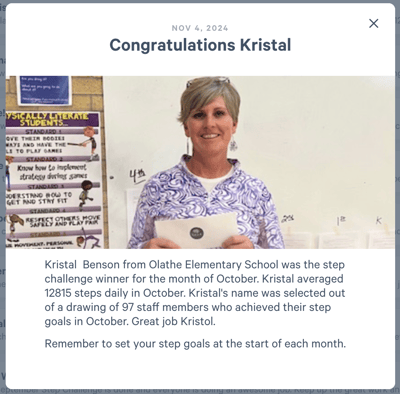
Montrose County School District (MCSD) understands that active staff will feel better and work better together. They use the Reward Gateway | Edenred wellbeing app to support MCSD’s goals of improving life for their employees. They hold short-term movement challenges, as well as monitoring monthly step goals for participants.
The individual nature of the monthly goals also means that all staff – from those just starting a fitness journey to those that bike or hike all the time – can have a reasonable goal to strive for. For any staff that increased their monthly step goal and then hit it, they were entered to win raffles that make the competition all the more compelling. Using this method, 57% of staff hit those monthly goals.
This approach to wellbeing kept it from falling by the wayside during busy times while building community and healthy habits.
Strengthen your employee wellbeing programs with Reward Gateway | Edenred
Balancing employee wellbeing and productivity isn't just possible – it's essential for sustainable business success. The evidence shows that when organizations invest in comprehensive wellbeing strategies encompassing support, connection, communication, and recognition, both employees and business outcomes thrive.
Reward Gateway | Edenred provides an integrated employee engagement platform that brings together recognition, rewards, wellbeing resources, benefits, and communication tools in one accessible place. Our solutions help organizations build cultures where employees feel valued, supported, and empowered to do their best work – driving the productivity and performance your business needs while prioritizing the wellbeing your people deserve.
Ready to transform your approach to employee wellbeing and productivity? Contact Reward Gateway | Edenred to learn how we can help you create a thriving workplace.
