








2026 Study: Fake Perks in Job Ads
Discover how job ads are misleading jobseekers with legal requirements as ‘perks’. Our study reveals the industries which are most transparent about salary and perks.
%20(1).jpeg?width=40&height=40&name=Alex%20Powell-7746%20(Med)%20(1).jpeg)

Job Advertisements Analysis – What are the Worst Perks Listed in Job Ads in 2026?
Employers in the UK are under pressure to advertise jobs honestly, as concerns about pay transparency and listing legal requirements as “job perks” increase.
There is also a rise in reports of “ghost jobs” online. These are ads for roles that don’t exist, intended to scout talent pools for future hires.
Reward Gateway | Edenred wanted to uncover the extent of this problem in 2026.
-
How many job ads don’t specify a salary?
-
What are the most common ‘fake perks’ mentioned in job ads?
-
Which industries are most likely to offer fake perks?
-
Which industries are the least honest about the salary offered?
We investigated current job advertisements to assess the extent of the issue, analysing almost 10,000 job adverts and the salary information advertised within them.
Our analysis focuses on salary figures and ranges listed in job postings, rather than the actual pay employees receive within those industries.
Our study reveals the vast number of job ads that promote basic entitlements like coffee or water as “perks,” as well as which industries are the least transparent about salary information.
Employers should offer meaningful benefits, not just basics like water or coffee. To attract top talent, explore our employee benefits solutions.
Now onto the findings…
Fake Perks in Job Advertisements
Nearly 1 in 5 job ads promote at least one legal or baseline entitlement as a “perk”
More than a fifth of 2026 job ads include basic legal requirements as 'perks.' Surprisingly, the most common was water.
Fake perks in job adverts are deceptive, exaggerated, or misleading benefits used to attract applicants to job postings.
These range from presenting legal requirements as perks to vague promises that never materialise.
Below, we can see the extent of these ‘fake perks’:
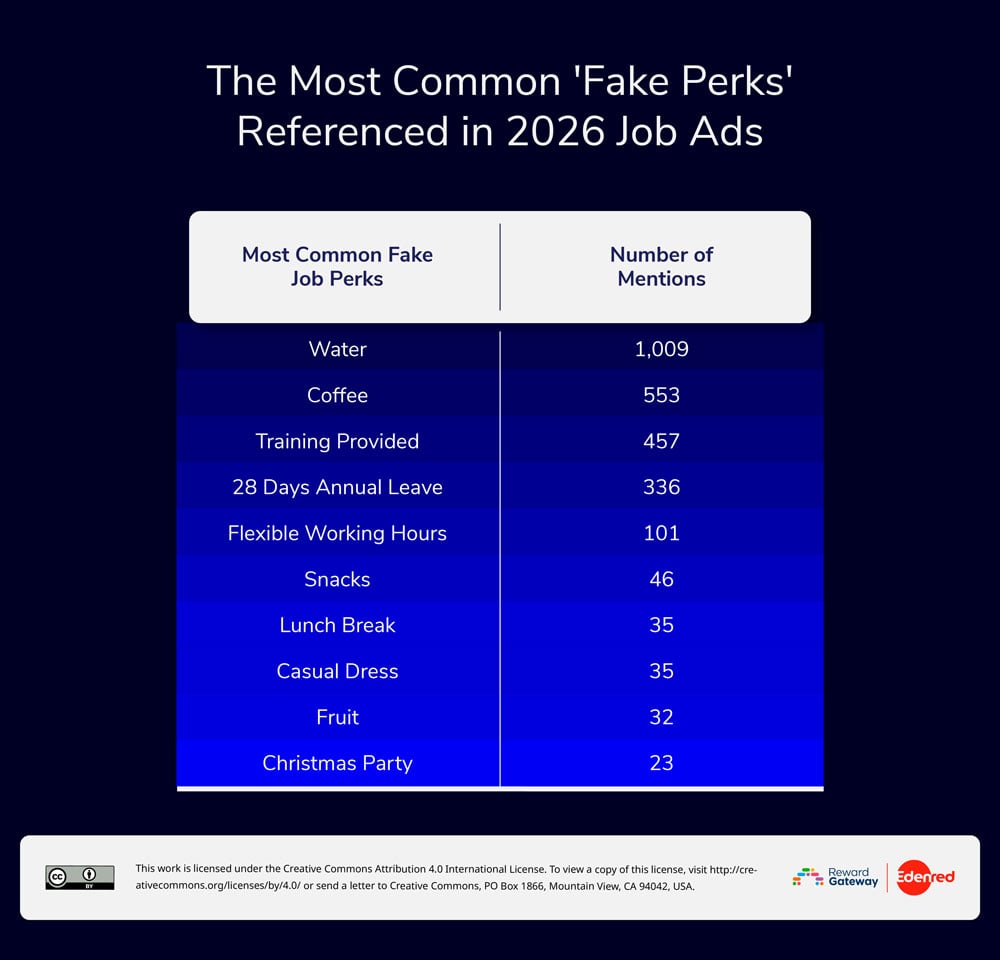
Water is listed as a perk in 1,009 job ads, while coffee appears in 553 adverts. 457 companies highlight training as a benefit, a requirement for fulfilling job responsibilities.
Our study shows 336 companies list 28 days of annual leave (the legal minimum) as a perk. Charity (63), social care (57), and sales (55) are most likely to do this.
While not often mentioned, some companies still list amenities such as snacks (46), fruit (32), casual dress (35), pizza (12), and the Christmas party (23) as employee perks.
Ping-pong tables are rarely mentioned, with only one company listing this as a benefit.
"It’s surprising that nearly one in five job ads still promote basic legal entitlements as perks and that salary transparency remains limited, with 30% of adverts providing no pay information says Chris Britton, People Experience Director here at Reward Gateway | Edenred.
“However, improving transparency is vital to helping both employers and employees. It enables candidates to make informed career decisions, while helping businesses attract and retain top talent.
Businesses should prioritise offering benefits that support financial, physical, and emotional well-being, instead of presenting basic entitlements as perks to enhance job attractiveness.
Industries with the Most ‘Fake Perks'
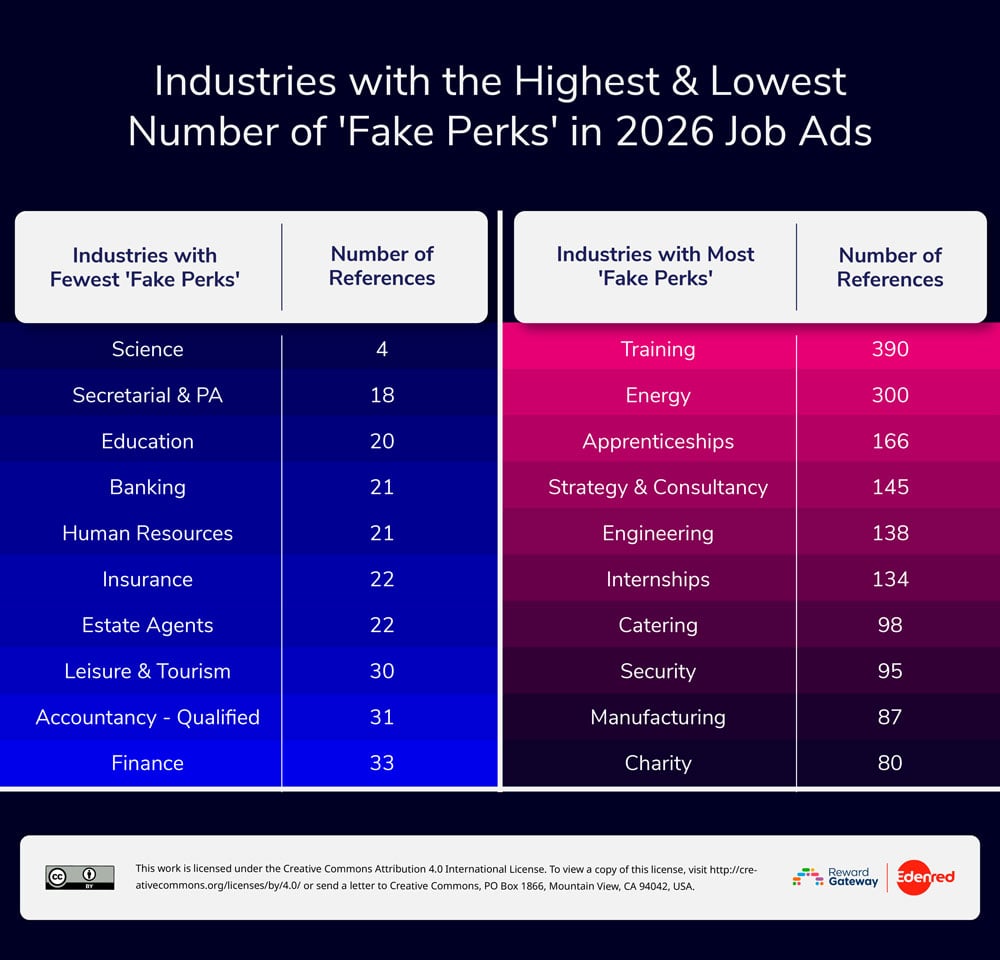
The training and development industry referenced ‘fake perks’ in their job ads 390 times.
Our study found that the five largest offending job sectors in terms of offering ‘fake perks’ were training & development (390), energy (300), apprenticeships (166), strategy & consultancy (145), and engineering (138).
On the other hand, the science (4), personal assistance (18), education (20), banking (21) and human resources (21) industries were the least misleading, all with under 25 mentions of ‘fake perks’ in their job ads.
Job adverts and salary information
Despite jobseekers saying they won’t apply for a role unless the salary is listed, 30% of the job adverts analysed in our study do not disclose any salary information, with the industries most likely to do this being strategy and consultancy (205), estate agents (154) and manufacturing (143).
Industries with the least transparent salary information
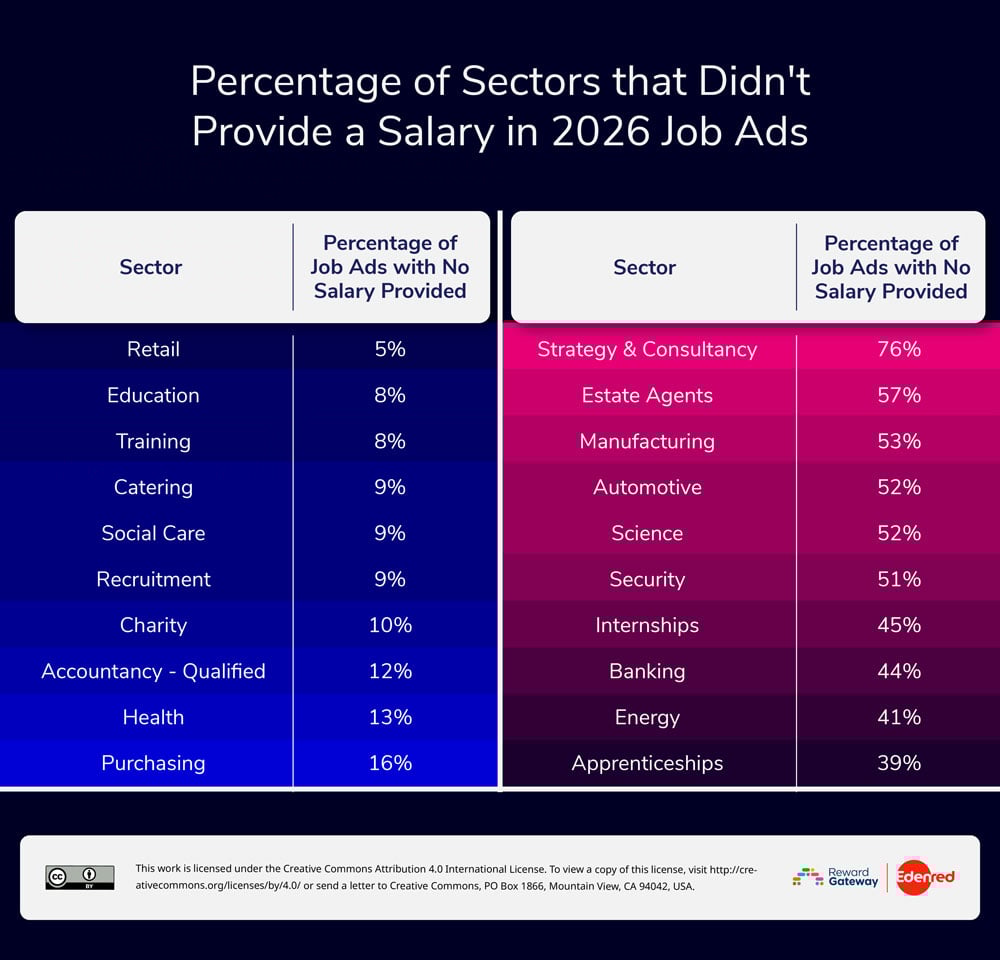
There are several possible reasons for these industries ranking as the least transparent when it comes to pay. Firstly, in sectors such as strategy & consultancy, employers frequently avoid disclosing pay details due to negotiation-based compensation and internal billing rates.
Estate agencies operate with compensation often tied to commission structures rather than clear salary bands. This likely contributes to pay details being omitted in job ads.
Salaries in manufacturing often include base pay, shift differentials, skill premiums, and location adjustments, leading companies to withhold fixed ranges until after candidate screening and negotiation.t transparent salary information and the fewest job ads without a salary provided are retail (14), education (20), training & development (22), social care (23), and catering (23).
Industries with the widest advertised salary ranges in job listings
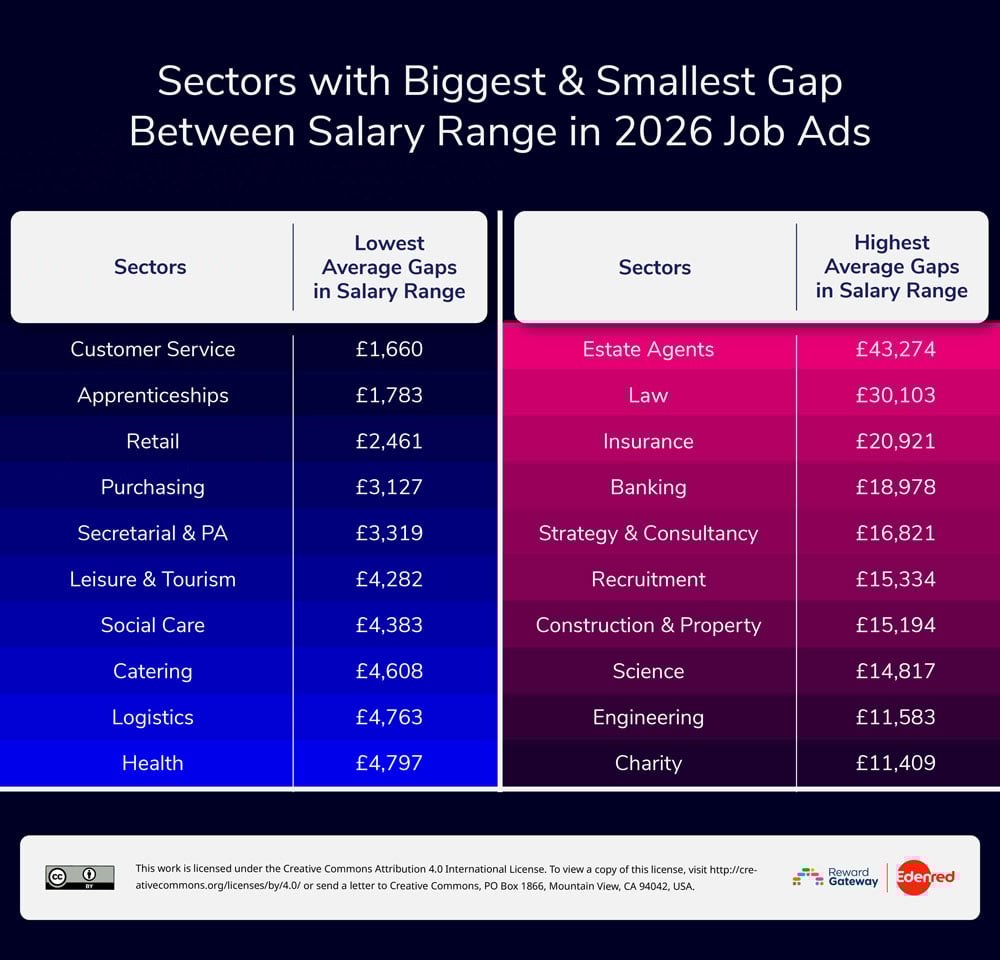
An important factor many jobseekers consider is the reliability of the salary range. Jobseekers can be put off by ads with wide salary ranges, as they don’t know what to expect, and it can be hard to compare against other jobs they’re interested in.
Our study showed that 17% of job ads have a set salary and 53% advertise pay ranges.
Companies often advertise pay ranges rather than a set salary to balance transparency with hiring flexibility. This helps businesses to attract a diverse pool of talent while accounting for different experience levels.
Across all job levels, the average gap between the lowest and highest salary figures advertised within job listings is £9,887.Wide bands can hide pay inequality, with people in the same role paid differently due to negotiation or tenure.
This lack of transparency can lead to unclear pay progression. Research shows 22% avoid ads with just a pay range.
The top three industries with the widest advertised salary bands in job listings are estate agents (£43,274), law (£30,103), and insurance (£20,921).This may be because pay varies significantly within the same roles and career stages.
In estate agency, earnings are commission-driven, so individuals in similar roles can earn very different amounts; typical UK pay ranges from £15,000 to over £90,000.
In law, salaries vary sharply by firm, location, and practice area, with newly qualified solicitors in City firms earning around £140,000, compared with £18,200–£30,000 for trainees in regional or public sector roles.
In insurance, role diversity drives wide bands: entry-level claims and customer service roles pay £20,000–£30,000, while technical specialists earn six-figure salaries. Variable pay, geographic differences, and scarce skills keep average bands broad across all levels.
Customer services (£1,660), apprenticeships (£1,783), and retail (£2,461) have the smallest salary bands.
Should job adverts show salary?
The UK government is considering stronger action on pay transparency and equal pay enforcement, as campaigners argue it’s time for employers to advertise jobs more honestly.
Research suggests 34% of UK job adverts may be “ghost jobs” – these are ads created for roles that don’t exist, with the intention of scouting talent pools for future hires – and in recent news, it was revealed workers in sectors like social care are given misleading hourly rates, which mask pay that falls below the legal minimum.
These actions have real consequences, leading to campaigns such as #SayThePay, launched earlier this year. This research reveals 64% of jobseekers say they won’t apply for a role unless the salary is listed, yet employers continue to withhold essential information while expecting candidates to put a huge amount of effort into the application process.
In Summary
A few highlights from our study include:
-
18% of job adverts list basic legal rights as benefits.
-
1,009 companies list providing water as a perk.
-
‘Negotiable salary’ was only referenced by two job adverts.
-
76% of Strategy & Consultancy job adverts did not provide a salary.
-
Estate Agency jobs had the widest advertised salary range, with an average gap of £43K across job listings that provided a salary range.
Methodology
The analysis focuses on salary figures and ranges advertised within job postings, rather than the actual salaries paid within industries.
Using the Screaming Frog SEO Spider, we scraped the first 10 pages of job ads on reed.co.uk across 37 job categories, filtering for full-time, permanent positions, resulting in 9,682 listings.
We searched these ads for mentions of common “trope” perks unlikely to positively impact employee wellbeing (e.g., water, 1-hour lunch, 28 days of annual leave).
We recorded listings with no salary or salaries listed as “competitive” without a figure.
Average salary gaps were calculated by combining the upper and lower pay scales within each profession and averaging them.
Attract Top Talent with Exciting Employee Benefits
If you want to attract top talent to your business, discover our employee benefits solutions today.
Salary Sacrifice | SmartTech | Cycle to Work | Holiday Trading | Car Benefit | EAP | Childcare Vouchers

.jpg?width=406&height=243&name=workplace-toxicity-concept%20(1).jpg)