




 Emily Mellwood

Every HR leader knows the power of recognition – to celebrate contributions in ways that feel authentic, timely and genuinely valued. Yet budgets aren’t one-size-fits-all. One team’s surplus might be another’s pipe dream. Rather than letting dollars dictate impact, focus on creativity and intention – the true drivers of memorable recognition.
Impactful appreciation rarely comes from spending alone. Personalization, timeliness and alignment with individual preferences are the true drivers of memorable recognition. Often, the most meaningful gestures cost little or nothing – time, a thoughtful conversation, flexibility or a public “thank you” consistently rank as some of the most valued rewards employees receive. Over 50% of employees even rank recognition for their efforts as more important than a 10% pay raise, and 85% of employees say feeling appreciated impacts their productivity. When those simple actions are paired with occasional tangible treats, the result is a culture that feels seen and sustained.
This post walks through practical, ready-to-use employee appreciation ideas grouped by budget – from $0 (read: free!) options that build everyday goodwill, to low- and mid-range choices ideal for spot recognition, all the way up to premium rewards for major milestones.
Use this as a toolkit: Mix free, low-cost and higher-value tactics to create recognition that’s frequent, fair and truly resonant with your people.
$0 employee appreciation ideas
When budgets are tight, your most valuable resources are time, attention and flexibility.
Some of the most meaningful recognition doesn’t cost a penny – it costs attention. When you invest time, specificity and flexibility, employees feel seen in ways a budget can’t buy. Zero-cost gestures are inclusive and scalable, and they’re often the fastest to implement, like a timely public shout-out, a peer nomination, a bit of schedule flexibility, a growth conversation or a handwritten note.
These small but intentional actions signal, “I notice you, I value your contribution, and I care how you prefer to be recognized,” creating everyday momentum for a stronger culture without adding to your spend.
1. Flexible time off and scheduling
Small moments of flexibility can feel like a big “thank you.” When someone goes above and beyond, acknowledge it with time back or control over their schedule.
Ways to do it today:
|
“Thanks for staying late to land the release. Please start an hour later tomorrow, and block your first hour for deep work – no meetings.” |
- Offer a late start or early finish after a crunch period, no extra approvals needed.
- Let employees swap shifts or choose preferred shifts when the schedule allows.
- Grant “flex hours” to run personal errands, with trust-based make-up time.
- Protect heads-down time by blocking calendars for deep work.
Make it fair and practical:
- Set simple guardrails so managers know what they can approve on the spot.
- Ensure frontline and shift-based employees get equivalent options (e.g., preferred shift selection, extended breaks, comp time).
- Anchor flexibility to outcomes, not hours, and track usage to avoid unintentional favoritism.
- Confirm compliance with local labor rules and staffing needs.
2. Public recognition
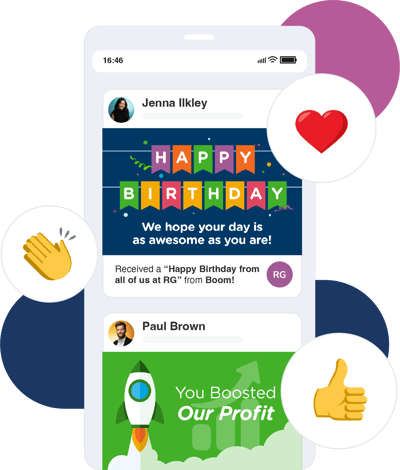
Public praise, done well, lifts the individual and models the behaviors you want to see across the team. Here at RGER, we send each other eCards on our own EXP, called boom!, to share great work, exciting moments and wins big and small with all of our colleagues across the organization. This helps cross-team transparency and collaboration and contributes to employees’ understanding of how their work fits into the bigger picture.
 Best practices:
- Be timely: Recognize as close to the event as possible, while the impact is fresh.
- Be specific: Name the situation, the action, and the outcome. At RGER, we call this the Action-Value-Impact model.
- Tie it to values: Connect the contribution to your culture. Match eCards to your company values so that employees can tag actions to the arms of your mission.
- Respect preferences: Some people prefer a quieter channel; ask in advance.
- Spread the spotlight: Everyone in the organization should have access to both send and receive recognition to anyone else.
Where to recognize for free:
- Slack/Teams kudos channels or a dedicated “wins” thread
- All-hands slides or a two-minute shout-out segment
- Intranet posts or an internal newsletter highlight
- A digital “recognition wall” with reaction and comment capabilities
3. Peer shout-outs
Peer-to-peer recognition scales appreciation beyond managers and surfaces contributions leaders might miss. Employees balance personal work with teamwork every week, and empowering them to recognize and thank each other is a huge boost to internal culture. It also helps to boost cross-departmental empathy and collaboration, reducing silos and .
| Starter Prompts: |
| Whose work made your week easier? |
| Who modeled our value ‘We own it’ this sprint? |
How to start:
- Add a five-minute “kudos round” to weekly team meetings.
- Pin a recurring kudos prompt in Slack/Teams every Friday.
- Use a shared doc where anyone can drop shout-outs throughout the week.
- Encourage emoji/react boosts so more voices can participate quickly.
Keep it healthy:
- Focus on behaviors and impact, not popularity.
- Invite quieter voices by prompting, “Who helped you move work forward this week?”
- Avoid tying peer-to-peer recognition directly to performance ratings; keep it safe and genuine.
- Make your recognition program multi-directional, so that every employee plays a role in building and continuing a culture of appreciation within your organization.
4. Career development opportunities
Growth is one of the most meaningful forms of appreciation – and many options are free when you leverage in-house expertise and real work.
Zero-cost ideas:
- Assign a stretch project with clear scope and mentorship.
- Offer a presentation slot at an all-hands meeting or a team demo.
- Set up a shadowing day with a cross-functional partner.
- Pair people for mentoring or reverse mentoring.
- Host an internal lunch-and-learns using team expertise – these can be as simple as software tips or as complex as process descriptions.
- Share time for free webinars or community meetups that align with goals.
Make it work:
- Ask in manager-employee 1:1s what skills each person wants to build; match opportunities accordingly.
- Rebalance workload so development time doesn’t become unpaid overtime.
- Debrief after the opportunity and capture outcomes in internal profiles or LinkedIn.
- Ensure frontline staff get equitable access (e.g., micro-learning huddles, on-shift shadowing, short rotations).
5. Handwritten notes
 A thoughtful note turns recognition into something people keep. It signals you took time to notice the details. Downloadable eCards serve a similar purpose while minimizing paper usage, which is important for many organizations with CSR and waste-reduction objectives.
Tips for impact:
- Be specific about what they did and why it mattered.
- Tie it to one or more of your organizational values – or its mission – to drive the importance of the contribution.
- Clarify the future impact their action will have on the team or the organization, or even a client. This helps drive the connection between job roles and organizational success, increasing an employee's sense of belonging and professional value.
Where to use them:
- Leave a note on their desk or include it with a shipped asset if they’re remote (or scan a handwritten note and share via email/DM).
- Post a digital eCard with a thoughtful message on your organization’s engagement platform, intranet or official chat app.
$25-$100 employee appreciation ideas
This tier sits in the “sweet spot” for many teams – offering enough budget to fund meaningful experiences and growth opportunities, while remaining accessible for mid-sized groups and lean budgets. When you invest in this range, you can move beyond small tokens to recognitions that feel substantial, shareable and memorable, all while keeping programs scalable and fair.
Pair thoughtful moments with opportunities for development or enhanced experiences, and you’ll create a cadence of recognition that’s meaningful without overwhelming your resources.
6. Professional development stipends
 A modest stipend sends a clear message: We invest in your growth. With $25–$100, employees can buy a book, enroll in a short course, attend a webinar or pay for a micro-credential.
Ways to implement:
- Offer a quarterly or annual micro-stipend (e.g., $50 per quarter) that employees can spend on learning resources.
- Approve spot stipends for role-specific needs tied to a stretch assignment or promotion path.
- Curate a short vendor list to simplify choices, but remain open to off-list options when presented.
Make it meaningful:
- Require a one-page share-back or five-minute recap at a team meeting to spread learning.
- Allow people to pool stipends for a larger course if that better suits their goals.
- Keep the approval process lightweight so managers can say yes quickly.
7. Catered team events
Food and shared experiences create connection and reward collective effort. With this budget, you can cater a team lunch, order snack boxes for remote staff or host a small offsite coffee hour.
Ways to do it:
- Set a per-head cap (e.g., $30/person) for lunches or snack boxes.
- For remote teams, send eGift cards or curated snack deliveries.
- Use local caterers to support small businesses and vary menu options for dietary needs.
Practical tips:
- Schedule events during work hours to maximize attendance and respect personal time.
- Rotate which teams get events, to keep it fair across the organization.
- Ask for dietary restrictions up front and offer vegetarian/vegan/gluten-free options.
8. Local experience passes
Small, local experiences are memorable and often low-cost: museum or zoo tickets, a pottery class or a fitness studio drop-in.
How to roll it out:
- Curate a list of vetted local partners and prices so managers can pick quickly.
- Offer a “choose your experience” voucher (e.g., $50 value) redeemable at participating venues.
- Make digital delivery easy with eVouchers or ticket codes.
Accessibility and fairness:
- Ensure options are accessible by location and physical ability, or provide equivalent virtual choices.
- Keep the per-person value consistent so comparisons don’t undermine fairness.
9. Choose your own reward marketplaces
 Marketplaces let people pick rewards that matter to them – gift cards, gadgets, experiences, donations and more – while keeping program admin simple.
Implementation tips:
- Set a clear dollar value per recognition (e.g., $50 for spot awards).
- Use a trusted marketplace to handle fulfillment and give a wide range of choices.
- Revisit the catalog periodically to keep options fresh and relevant.
Program best practices:
- Combine marketplace rewards with a public recognition moment to amplify impact.
- Use analytics from the marketplace to understand preferences and tailor offerings.
10. Subscription bundles and services
Short-term subscriptions – wellness apps, learning platforms, curated snack boxes or meditation services – deliver repeated value beyond a single moment.
Ways to offer:
- Gift a 3-6 month subscription aligned to individual interests (e.g., Headspace, a language-learning app, or a specialty coffee subscription).
- Offer a menu of subscription options and let employees opt in to the one they prefer.
- Trial subscriptions are a low-risk way to test interest before committing further.
Things to watch:
- Check tax and expense implications for your jurisdiction.
- Allow transfers if someone already subscribes to avoid waste.
- Encourage recipients to share their experience in dedicated conversation threads– subscriptions create ongoing conversation points.
$100+ employee appreciation ideas
This tier is built for milestone moments and standout contributions – anniversaries, major project wins, top performers or retention-driven rewards – where the investment should match the significance of the achievement.
When you move into higher-value recognition, you can create experiences that feel truly celebratory and lasting, and – perhaps unsurprisingly – those principles of personalization and flexibility are critical here.
Use these budget levels strategically and transparently. Reserve premium rewards for occasions that warrant them, communicate the criteria clearly and pair big gestures with frequent, smaller acknowledgments – so recognition feels continuous, rather than rare. Thoughtful execution turns an expensive gift into a meaningful milestone that reinforces the behaviors and commitments you want to encourage.
11. Performance bonuses and spot awards
| “Thank you for leading the incident response that protected customer data and restored service. Your impact was significant and aligned with our value of ‘Own It.’ We’re recognizing you with a $250 spot award, effective this pay cycle.” |
High‑impact moments deserve high‑impact rewards. A timely bonus or spot award reinforces standout performance and signals that exceptional effort is noticed and valued.
Ways to implement:
- Set clear tiers (e.g., $100, $250, $500+) mapped to impact levels and allow managers to approve within guardrails.
- Define criteria upfront—tie awards to values, revenue impact, customer outcomes, safety, or quality.
- Enable quick nominations from peers and cross‑functional partners to surface hidden wins.
- Pay rapidly, ideally in the same month the achievement occurred, and pair with a recognition moment.
Fairness and compliance:
- Communicate eligibility and criteria to avoid bias or surprises.
- Track distributions by department, tenure, and demographic segments to ensure equity.
- Coordinate with payroll for tax implications and to distinguish bonuses from base pay or commissions.
- For hourly/shift staff, ensure timing and amounts comply with local wage rules.
12. Premium gadgets
The right gear can feel like a treat and improve daily work. Let people choose what genuinely helps them focus, create or recharge.
Great options:
- Noise‑canceling headphones, ergonomic keyboards/mice, high‑quality webcams or lighting.
- eReaders, smart notebooks or desk wellness gear (footrests, lumbar supports).
- For makers: digital pens, drawing tablets or specialty tools aligned to the role.
Implementation tips:
- Offer a curated menu with a per‑person cap and a “choose your own” option for accessibility.
- Ensure compatibility with company devices and provide basic setup support.
- Offer an equivalent cash/value alternative for anyone who prefers not to receive hardware.
13. Company-sponsored retreats and offsites
 Shared experiences build trust and momentum. A thoughtfully designed offsite can celebrate wins, deepen relationships and align teams for what’s next.
Make it meaningful:
- Set a clear purpose (retrospective, planning, celebration) and balance work with rest.
- Keep the agenda inclusive: small-group sessions, optional activities and accessible venues.
- Host during work hours to respect personal time and reduce barriers to participation.
- For distributed teams, provide travel support and virtual alternatives for those who can’t attend.
Equity and logistics:
- Publish selection criteria for who attends (e.g., project team) and rotate opportunities.
- Offer an equivalent experience or stipend if someone cannot travel due to external life constraints.
- Share a code of conduct and safety guidelines; ensure dietary and accessibility needs are covered.
14. Spa day certificates
Wellness rewards help people recharge after intense efforts. Spa certificates, massage sessions, or wellness experiences can feel restorative and personal.
How to offer:
- Provide a flexible wellness voucher redeemable at multiple local providers or a national network.
- Include alternatives like sports massage, acupuncture, meditation retreats, or fitness passes.
- Allow recipients to choose timing and provider to match comfort and preferences.
Considerations:
- Communicate any tax implications and expiration dates up front.
- Ensure options are inclusive and culturally sensitive; offer non‑touch alternatives for those who prefer them.
- Provide an equivalent value for employees in regions without partner coverage.
Sample wording:
“Thank you for going above and beyond this quarter. Please enjoy a $150 wellness certificate—choose the experience that helps you unwind, from massage to a meditation day pass.”
15. Professional certification course reimbursements
 Investing in credentials validates expertise and can lift career trajectories. Covering exam fees, prep courses, or membership dues shows long‑term commitment.
Ways to implement:
- Publish a list of pre‑approved certifications by role, with reimbursement caps (e.g., up to $500 per year).
- Offer upfront payment vs. reimbursement to avoid out‑of‑pocket strain.
- Provide study time (e.g., a few protected hours per week) and an exam day.
- Capture outcomes in internal profiles and celebrate achievements publicly, with the recipient’s approval.
Policy best practices:
- Keep criteria transparent: eligible certifications, maximums, retake policy and any service commitment.
- Ensure parity across functions—recognize technical, operational, and customer‑facing credentials alike.
- Track utilization and impact on career progression to inform future investment.
How to choose the right staff appreciation ideas for your budget
Choosing the right mix starts with clarity and intent. Your goal is the same across budgets – recognition that feels fair, frequent and personal – so build a simple plan that matches your resources to the moments that matter.
Start with budget, team size and cadence
Work backward from what you can sustain. Define your annual recognition budget, your headcount and how often you want each person to feel recognized. A quick guide: average spend per recognition = total budget ÷ (headcount × target recognitions per person). Set a baseline cadence – for example weekly peer kudos, monthly manager spot recognition, annual milestone moments – then right‑size the spend to fit.
Blend free, low and premium tactics
A blended plan reaches more people without losing impact. Use $0 ideas for everyday behaviors, $25–$100 for sprints and stretch efforts, $100+ for milestones. Map tactics to moments so criteria are clear and repeatable. Always provide equivalents for frontline and distributed teams – time swaps or comp time for flexibility, digital vouchers for on‑site perks, virtual options for in‑person events.
Let preferences guide the reward
Preference fit drives meaning more than cost. Capture simple recognition profiles in onboarding and 1:1s – public or private, time off or gift, food choices and accessibility needs, growth opportunities or gadgets. Offer choice where possible through a marketplace or a short menu so people can select what resonates. When a preferred option isn’t available, provide an equivalent alternative of equal value.
Favor frequency and timeliness over size
Small and soon beats big and late. Aim to recognize within a few days of the contribution and prioritize more touchpoints at modest amounts over rare splurges. Keep approvals lightweight so managers can act within 48 hours. Pair every reward with a specific message about the behavior and impact – the story is what makes the moment memorable. Track reach and equity monthly to ensure recognition is distributed fairly and your budget is working where it matters most.
Make employee appreciation a part of every day with Reward Gateway | Edenred
Recognition works best when it’s consistent, personalized and woven into the fabric of daily work life. Reward Gateway | Edenred offers tools that make it simple to blend zero-cost gestures with tangible rewards – all aligned to individual preferences and your budget. From peer-to-peer shout-outs to curated reward marketplaces and milestone bonuses, you can create a recognition program that scales with your organization and keeps momentum high.
With seamless integration across communication channels and personalized options for every employee, you’ll foster a culture where appreciation is frequent, meaningful and celebrated company-wide – and, more importantly, built into the fabric of your culture.
Ready to get started building your own culture of appreciation and recognition? Schedule a demo, and one of our friendly employee experience experts will show you how together, we can make your corner of the world a better place to work.
