




%20(1).jpeg) Alexandra Powell
Alexandra Powell

A new survey by Kahoot! has found that 39% of office workers feel disconnected on the job. Further that nearly one-third say they often go an entire workday without speaking to a colleague.
 In 2025, we found that Millennials are the generation most likely to feel lonely, and that 1 in 5 men and 1 in 8 women have walked away from a job due to feeling disconnected from coworkers. And the Harvard Graduate School of Education found that those that earn less money are more likely to be lonely than those that earn more – so we should keep an eye on our frontline teams.
Keep in mind that loneliness isn’t just about those that are physically alone, but those that don’t have quality relationships. A team member may work in a retail location all day, but if they don’t feel comfortable or welcomed, they can feel more alone than someone that always works from home.
How does loneliness impact communities?
Loneliness isn’t just an individual problem. Societies with higher levels of loneliness show trends that impact us all.
- Mental health declines: Not surprisingly, increased levels of loneliness and a lack of connection have wider impacts on mental health. Loneliness is linked to increased rates of depression, anxiety and even suicidal ideation.
- Physical health risks: In a country for whom health care is a challenge, increased loneliness can also impact physical health. Heart disease, diabetes, and even increased risk of dementia and death are associated with feeling a lack of connection.
- Reduced social cohesion: Loneliness and feelings of disconnect can also lead to people not trusting their community. This can then spiral as people’s lessening trust in others means they are decreasingly likely to see value or feel comfortable participating in their community.
- Increased societal costs: The culmination of these trends leads to American’s being less productive, less employable and requiring increased access to health care.
How does loneliness impact your workplace?
The same trends that impact our communities impact our workplaces.
Employees are less likely to trust and collaborate – meaning less innovation and efficiencies being unlocked. Additionally, lonely employees are more likely to get sick, burn out, be absent or lack the energy to be at their best. Gallup found that lonely employees are less motivated and engaged. Within the workplace, know that Millennials and managers are lonelier than most.
Does this make the case for Return to Work?
Maybe. Those that always work from home are lonelier than the average in Gallup’s research (25% lonely vs. 16%). But those that work onsite also report higher levels of burnout (29% vs. 24%) than those that work fully remote. It appears that fully on-site and fully remote employees can each have associated impacts to their mental health.
What can organizations and teams do to address increased loneliness?
What can you do – in your corner of the world – to combat an “epidemic of loneliness?” Lots, actually. And managers already know that. Our Building Human Workplaces report shared that 71% of them feel responsible for their team’s wellbeing. So what can we do (or give them to do) to connect and engage our teams?
Make meetings more social
Maybe it’s the five minutes at the start of a regular meeting or the first few questions you ask in a one-on-one, but giving employees permission to chat about their lives can do a lot for day-to-day connection. One of our clients – Ulteig – recently shared in a webinar that they pair employees up to have a chat and get to know each other. You can use a formal system for this or just encourage your people to put “connection” meetings on the calendar with those you don’t know as well.
Build social interactions into chats
We often spend large parts of our day in various work chats. Taking time to put topics or questions of interest into those chats to engage people in non-work conversation can do a lot to build connection. It could be asking which summer blockbuster movie people are most excited about or – in the case of our team – “Would you Rather” Wednesday when we ask people to pick one of two (often unpleasant) scenarios. Leading the charge on this can fall on a manager for consistency, or it can be lead by a team member with the creativity and interest to keep it going long term.
Promote Employee Resource Groups (ERGs)
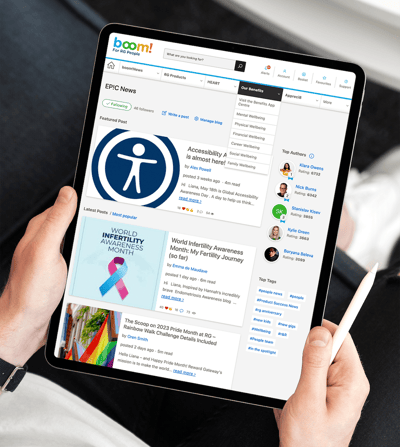 Having connections outside your functional team can help – especially if that group is associated with a topic you are passionate about. I am a lead of our Reward Gateway | Edenred Accessibility Network and love talking with colleagues about ways to ensure we are being welcoming to employees, regardless of disability. We have a Multicultural, Social Mobility, LGBTQIA+, Women’s, Wellbeing and Accessibility Network, but many of our clients also have groups for those passionate about running, crafting, baking, reading, etc. These groups can be established and run by employees and just need a way to stay connected.
Encourage carpools or commuter groups
Connecting people that are commuting from the same town or neighborhood and encouraging them to carpool can support your sustainability or CSR goals, as well as provide employees with another team to connect with. Even those that already take public transport, can coordinate their travel so they have a friendly face on the train with them. If you have employees that bike to work, it can be especially helpful to have a colleague along in case of unexpected mechanical problems.
Host quarterly challenges or contents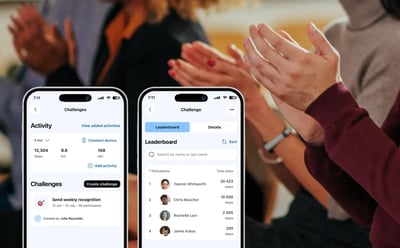
Whether it is fantasy football groups, NCAA bracket groups, or a wellbeing challenge, giving employees a topic to smack
talk about – sorry, talk about – outside of work projects can do a lot to bring more fun and deeper connections into the workplace. Our wellbeing app has a chat feature that clients like to use just for this purpose.
Make recognition easy - and remind them to do it
Knowing that others around you appreciate you and your work will inherently build stronger connections. In our Workplace Wellbeing report, we shared that 69% of employees say their workplace wellbeing would improve if they were thanked more! Remind people that when they see great work , they should say something. In person is great, but extending that praise out onto a social feed for all to see is better. This is a passive, positive way for us to learn what is happening across the organization and can build back trust that has been lost in those that feel less connected. “IT never responds to me” can become “Our IT team really is handling a lot. I understand why it sometimes takes a day for them to return my message” when recognition stories are elevated and talked about.
Learn more about how Reward Gateway | Edenred can help you build community and connection among your people and make your corner of the world a better place to work.
