








Why culture only changes when engagement participation improves
Employee engagement initiatives fail when they require additional effort to participate in. Learn how to drive lasting cultural change by turning engagement into a fully integrated daily practice.


Improving employee engagement, reducing turnover and ultimately changing culture is a complex challenge that requires insight, action and strategic integration into daily work life. Change happens iteratively rather than as a result of standalone initiatives. Exploring the key between effortless participation and engagement helps organisations take the most crucial steps toward lasting change.
It’s easy to fall into the ‘big bang’ trap when you start thinking seriously about improving culture and elevating engagement levels. An organisation will often design and launch a series of ambitious campaigns – like introducing a new annual survey, planning a one-off ‘recognition week’ or running a company-wide leadership roadshow – and expect to see a wave of cultural transformation. But, spoiler alert… they don’t get the results.
While these kinds of one-off pushes will often result in a temporary spike in enthusiasm, they’re unlikely to move the needle in the long-term. Engagement levels and company-wide sentiment inevitably return to baseline in the weeks and months following the event or campaign.
That’s not to say that ad-hoc engagement activities can’t be a valuable addition to a more sustainable rolling strategy that focuses on embedding employee engagement into the daily rhythm of work. But true cultural shifts don’t happen during recognition weeks and town hall events; they happen in the everyday moments that come in between. To achieve real impact and lasting outcomes, like higher productivity and lower employee turnover, we need to begin thinking about engagement as a daily practice rather than a one-off campaign or broadcast event.
This is where the importance of participation comes in.

When getting involved in communication, recognition, connection or feedback requires significant effort, employee participation remains low. Which directly correlates to significantly reduced outcomes, a disappointing ROI, and a far smaller opportunity for lasting cultural change. The key is to reduce friction by streamlining integration.
Behavioural science consistently tells us that people’s habits are more likely to change because something is easy – not necessarily because it’s important. So when engagement is effectively integrated into the natural flow of day-to-day work, it stops feeling like ‘one more thing to do’ and just becomes part of life at your organisation. It turns into ‘the way we do things around here’, which, as we know, is the backbone of company culture.
How to make employee engagement a daily practice
The all-important move from occasional campaigns to habit formation at work needs to be an intentional shift across all levels of the organisation. To make employee engagement a daily practice, participation must feel effortless. And for this to happen, the strategy needs to be designed in a way that aligns with human behaviour. Employees will only create habits and routines around tools that are frictionless, accessible and feel genuinely valuable.
Transforming engagement into a seamless daily practice requires three conditions:
Visibility:
When employees need to search through multiple different bookmarked links or log into disjointed portals to read a company update or log a recognition card for a colleague, participation remains low. Out of sight is out of mind. People need to be able to easily see what’s available to them within the key tool(s) that they access every day.
Simplicity:
As a general rule of thumb, participation should take seconds, not minutes. The moment a simple engagement-related action feels more like a multi-step task, people will give up and move on to something else.
Relevance:
We already know that generic broadcast-style information and content turns people off. One size will never fit all. So engagement needs to feel tailored to each individual employee. Personalised content like local peer recognition, tailored communications or targeted wellbeing benefits helps employees to immediately see the benefit of participating.
When these conditions are met, and the three pillars intersect, engagement stops feeling like an additional administrative task and starts to become habitual and sustainable.
Unified experiences versus fragmented tools
The delivery of your embedded engagement approach needs to be a key consideration. Because even if the strategy hits the conditions of visibility, simplicity and relevance, it can still fall flat and lack impact if the delivery feels disjointed. If people need to access multiple different systems and platforms to carry out a simple task or find a basic piece of information, the friction is simply too high. Employees don’t build habits across five different systems – they build habits in one central place. 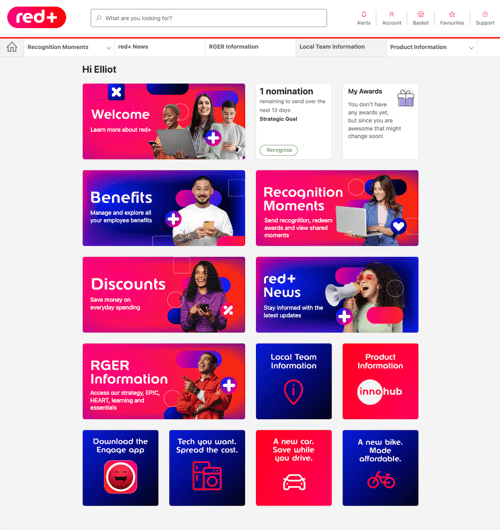
The reality is that unified experiences will always outperform fragmented tools.
Consolidating key touchpoints to create a unified employee experience significantly reduces the cognitive load. Because when a single, centralised platform houses things like communication, recognition, benefits and wellbeing, they stop feeling like isolated HR initiatives and become more connected. This unified approach is what increases repeat usage and creates a single ‘home’ for culture.
This is exactly why we see consistently higher participation rates with our EngagementOS. By getting rid of the digital friction created by platform hopping, it makes employee engagement a seamless part of the everyday workflow. It’s been specifically designed for everyday use rather than occasional engagement, and our clients see real results from that important reframing.
Practical steps to make participation effortless
We’ve already established that creating a sustainable culture requires engagement to be directly embedded into the daily rhythm of work. But what can leaders do today to reduce friction and start making participation feel effortless?
I always recommend looking at this task as an ongoing cycle rather than a one-off project. To truly make engagement participation feel effortless, positive habits need to be continually reinforced across the organisation.
1. Review daily touchpoints:
Periodically map the touchpoints where employees are spending their time to build an understanding of what day-to-day workflows are currently looking like.
2. Reduce any friction:
Based on the review, begin removing barriers by consolidating tools, simplifying access and reducing the number of log-ins required.
3. Introduce prompts:
Leverage gentle nudges to reinforce positive behaviours. Well-timed prompts keep connection, recognition and communication top-of-mind for employees and managers without feeling intrusive.
4. Celebrate micro-moments:
Look beyond major milestones like work anniversaries or new client wins. Actively highlight the everyday wins and small displays of your organisation’s values. Normalising this kind of real-time appreciation is what reinforces a positive culture on a daily basis.
Daily engagement drives measurable outcomes – cost savings, improved employee retention and productivity. But often we need a more solid guarantee of ROI to secure budgets and initiate positive change.
This is exactly why Reward Gateway | Edenred is now providing a Financial Return Guarantee – a commitment that your investment will deliver measurable financial value that exceeds its cost. We’re able to ensure that when you build the habit, you will also secure the return.
To learn more about the Financial Return Guarantee and discuss how we can help your organisation integrate engagement into daily life, get in touch with our team of experts for a chat.

.jpg?width=406&height=243&name=workplace-toxicity-concept%20(1).jpg)