








How strong people managers drive employee happiness and free up HR time
Discover how powering up your leaders can boost employee happiness, drive measurable business returns and free up HR resource for more strategic priorities


‘Management quality’ has been uncovered as one of the top drivers of employee happiness in the UK, and twice as important to employees as pay
Our most recent research, conducted in partnership with the London School of Economics (LSE) found a strong association between effective management and employee happiness, as well as both employee productivity and overall firm performance. Employees with a manager who they feel supported and encouraged by are shown to be 74% more productive at work, 73% more likely to stay in their role, and 71% more motivated to go above and beyond their usual work duties.
The positive impact that strong people managers have on the employee experience is undeniable. And it’s one of the key reasons why an increasing number of HR leaders are setting out to decentralise ownership of the employee experience, shifting day-to-day responsibilities from central HR teams to local people managers. The desire to move toward a decentralised model is compounded by our latest research, which highlights key links between people manager skills and employee happiness – a measurable driver of productivity and organisational performance.
But there’s a notable gap, with only half of employees actually reporting feeling happy at work.
Understanding and cultivating the link between people managers and employee happiness is a critical part of successfully decentralising HR and empowering people managers to take greater ownership. So, in this blog post, we dive deeper into the new research to explore the link between people manager skills and employee happiness, considering the gap that needs to be filled.
Let’s dive in.

The link between strong people manager skills and employee happiness
The research looked at the most significant drivers of employee happiness. It found that what matters most, by a considerable margin, is the quality of interpersonal relationships and connection at work. Especially with managers.
These interpersonal connections are roughly twice as influential as pay, and over four times as influential as both opportunities for progression and work autonomy.
So what are the enablers of these high-quality interpersonal relationships between employees and their managers?
Our research points to one clear thing – people manager skills. The leaders with the strongest people manager skills were the ones who were most effectively communicating with their employees, providing support and guidance. This directly correlates with higher levels of employee happiness, which, in turn, is shown to result in a 12% increase in productivity, a 30% improvement in retention, and a 20% growth in firm value.
It’s clear to see that investing in the development of high-quality people managers yields great results and can offer a very demonstrable ROI.
What role can people managers play in decentralising HR?
95% of HR managers say there are certain areas over which they’d like to see people managers take greater ownership, and not without good reason.
Embracing this type of decentralisation, where managers take more control of their team’s people initiatives, can directly improve the employee experience and drive HR impact. Because without effective lines of communication, trust and respect between people managers and their employees, central engagement initiatives all too often fail to translate to behavioural change.
Aside from enabling more direct employee support and promoting greater utilisation of people programmes, the decentralised approach also presents increased opportunities to develop those all-important interpersonal relationships between employees and managers.
Investing in the development of strong people manager skills is also one of the most effective ways to enable central HR functions to redirect time and resources to the more strategic firm-wide initiatives. And this opportunity to drive greater ROI is more important than ever, with two-thirds of HR professionals in the UK having experienced budget cuts over the past year.
Direct managers are already the frontline of HR, whether we acknowledge it or not. But HR intervention is required to enable and empower our line management populations by building the crucial people manager skills that will get us to a place of effective decentralisation.
The current gap in people manager capacity and effectiveness
With 50% of employees currently feeling unhappy at work and managerial relationships sitting squarely at the top of the list of influencing factors, there’s clearly a gap that needs to be addressed. Our research shed some light on this gap, uncovering a few uncomfortable truths.
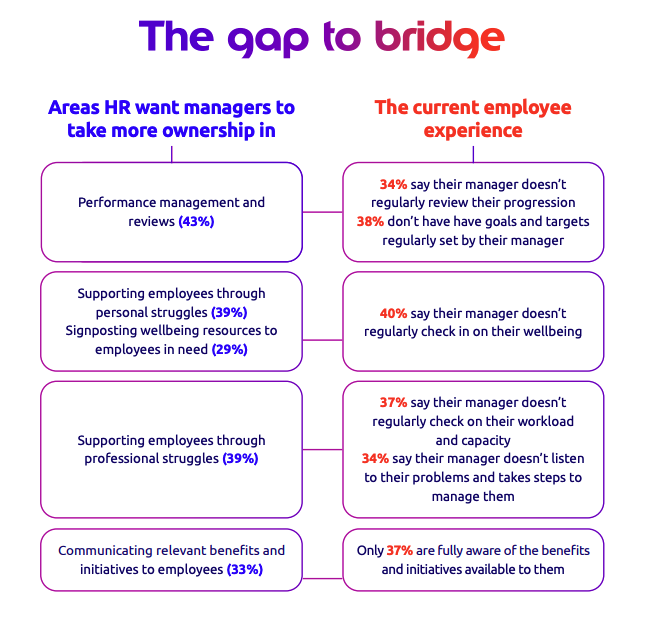
A third of managers were found to be neglecting even the most basic of people management responsibilities, including failing to set goals, monitor workloads or review progression with their team members. And this is being directly felt by employees, with 34% saying their manager does not regularly review their progression and 37% reporting that their manager doesn’t check their workload or capacity.
Despite 87% of HR managers saying they are confident that they provide line managers in their organisation with “...the necessary tools and information to effectively communicate employee benefits, initiatives and wellbeing resources to their teams”, only 37% of employees are aware of the benefits and initiatives available to them.
So where’s the block?
We found that only 57% of people managers feel supported and enabled to be a great leader, with 21% flagging that they were not offered sufficient training when they took on people management responsibility. This is leading to more than a quarter frequently experiencing burnout, and 40% of their team members thinking their manager doesn’t care about their wellbeing.
Why don’t people want to be managers?
When we consider all of that, it’s not surprising that 44% of employees say they’d prefer to progress their career without having to become a people manager.
There’s a need for an urgent intervention.
The line manager ‘failings’ that are killing the desire for employees to take on people management responsibilities are systemic, not personal. HR teams need to take action to reposition people management as a more attractive progression path, closing ‘the gap’ by providing more effective guidance and support for managers.
5 steps to manager empowerment
Here are five practical ways that HR leaders can promote and encourage strong, supportive people managers within their organisations:
- Co-design initiatives: Involve people managers in the development of people-related initiatives from the very start. Consider forming a ‘Manager Advisory Board’ to pressure-test initiatives, benefits and campaign ideas.
- Establish a ‘Management Framework’: Set clear expectations for manager-led engagement, defining exactly what the partnership should look like and laying a blueprint for what ‘great people management’ looks like within your organisation.
- Create a support ecosystem: Develop a self-sustaining structure for supporting people managers, including opportunities for peer learning from ‘manager champions’ and access to high-impact manager resources.
- Provide manager KPIs: Provide a clear set of ‘leading indicators’ (manager actions) and ‘lagging indicators’ (employee outcomes) to encourage managers to measure what matters.
- Normalise and model psychological safety: Think about the ways that conversations and briefings with managers can shift from ‘evaluation’ to ‘enablement’ to position HR as a true ‘success coach’ with aligned goals.
Powering up your managers in 90 days
Our new eBook, Powering Up Managers, provides a comprehensive 90-Day Roadmap to support HR teams in enabling and empowering managers right across their organisations.
The roadmap gives HR teams a clear and practical path to activate and empower people managers, with each phase highlighting the priorities that matter most, with immediate quick wins, mid term capability building and long term cultural embedding.
The 90-Day Roadmap presents a set of HR actions along with the desired outcomes and outputs for three separate phases, designed to unlock the potential of your leaders.
Get in touch with our team to explore how our leading employee engagement system can help you empower your managers, free up HR capacity and deliver measurable ROI for your people programme.

.jpg?width=406&height=243&name=workplace-toxicity-concept%20(1).jpg)