








Workplace perks vs vacancies by industry
Discover which UK industries offer the most and fewest workplace perks, and whether the sectors with the most vacancies are doing enough to attract talent.


According to recent news, rising redundancies and heightened job insecurity have driven a sharp increase in UK jobseekers, even as the permanent hiring market shows its first signs of recovery in nearly four years.
At the same time, The Happiness Dividend, a report from Reward Gateway | Edenred in partnership with the London School of Economics, found that happier employees are 30% less likely to leave their role within the next year, making what employers offer their people more important than ever.
But what are people really looking for in a new job?
While salary remains the number one consideration, research suggests that what workers want is multidimensional, with better benefits (39%) being the second most important consideration for UK jobseekers.
With this in mind, Reward Gateway | Edenred analysed 8,714 UK job adverts across 37 industries, along with the perks and salaries advertised within them, to reveal which sectors offer the most and fewest workplace perks, and whether the industries with the most vacancies to fill are doing enough to attract candidates.
The questions we wanted to answer were:
- Which UK industries offer the most perks per job?
- Which UK industries offer the fewest perks per job?
- Are the sectors with the most vacancies doing enough to attract talent?
- Do the best-paid sectors also offer the most perks?
The analysis scored every industry on the number of perks advertised per 100 jobs sampled, counting everything from private healthcare, pensions and bonuses to flexible working and extra holiday.
Top 10 industries offering the least perks on average
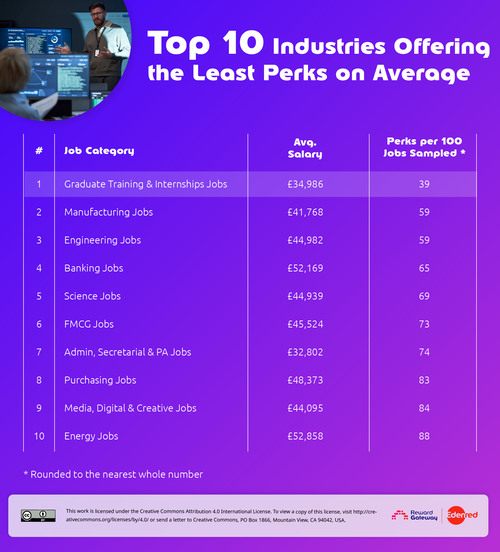 The sector advertising the fewest perks is graduate training and internships, which offer just 39 perks per 100 jobs sampled.
The average graduate role in the UK receives around 140 applications, according to the Institute of Student Employers, and competition is fiercer still in the most sought-after fields.
There are around 205 applications per role in digital and IT, 188 in financial and professional services, and more than 200 in media and law.
When employers are this heavily oversubscribed, there is little pressure to sweeten job offers with additional perks, which is perhaps why the number recorded in this study is so low.
Manufacturing has the second fewest perks, at 58.98 per 100 jobs sampled. Part of the reason could be because most manufacturing roles are site-based, which means there is a limit to some of the perks that can be offered like flexible, remote or hybrid working.
ONS data shows manufacturing is among the industries least likely to offer hybrid working and other research suggests it’s likely to offer pay incentives instead, with nearly half (47%) paying a premium for permanent night shifts.
Banking is in fourth place, perhaps because it is common for base pay to be fixed, with a focus on supplementary bonuses. Since UK regulators scrapped the EU bonus cap, banks have been able to pay bonuses worth up to 10 times base salary, and top payouts have climbed to their highest levels in over a decade.
Engineering has more live vacancies than any other sector analysed, yet ranks among the worst for workplace perks
Engineering is third from the bottom of the table, and has the most live vacancies of any sector analysed. It has 6,975 live roles and 59.13 perks per 100 jobs sampled. Could this be a sector where underused benefits could help recruit much-needed talent?
Research shows finding those with the right skillsets is proving tough, with 76% of engineering employers saying they struggle to recruit for key roles.
Top 10 industries offering the most perks on average
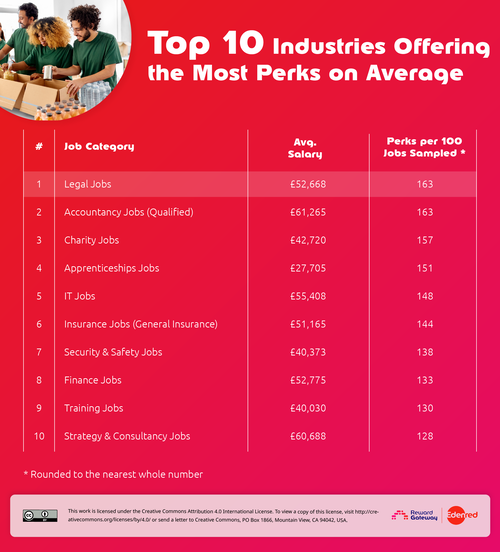
The legal industry offers the most perks on average, with 163 perks offered per 100 jobs sampled. Research shows law firms are competing hard to attract and retain talent, increasingly through benefits rather than pay alone.
And the stats are impressive. 93% of law firms pay pension contributions above the statutory minimum and 96% offer private medical insurance, while retention is increasingly driven by non-financial factors like wellbeing support.
In second place is qualified accountancy, which is also the highest paying sector of all 37, at £61,265 for its average salary. Here, top pay and top perks go together. Accounting and finance technicians are among the ten most critically in-demand occupations in the country. With qualified talent scarce and easily poached, strong benefits matter as much as pay in attracting top talent.
The third most generous sector for perks is charity, at 157 perks per 100 jobs sampled. Its salary sits around the middle of the table, showing that a strong benefits package does not always follow the biggest pay packet.
The legal industry leads the way with the most perks per job
Charities cannot always match higher corporate salaries, so they often compete on non-financial perks instead.
Lower pay is typically compensated with time off, often 25 to 34 days’ holiday, plus flexible hours and sabbaticals. Other frequently offered perks, from season-ticket loans to cycle-to-work schemes, are largely cost-neutral to most charities but highly valued by their staff.
The most popular perks overall
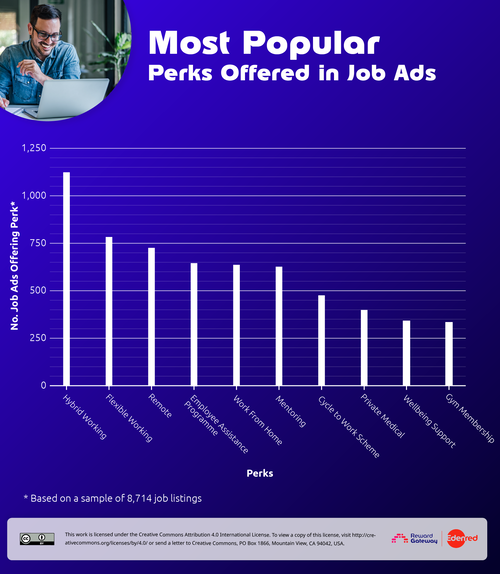 Of all the perks analysed, hybrid working proved the most popular with a total of 1,121 mentions across all industries.
According to the latest figures, 28% of British adults were hybrid workers in 2025, a proportion that has risen steadily since the spring of 2022.
Hybrid, flexible and remote working, along with working from home, together have 3,258 mentions. That's more than the other six perks in the top 10 combined (2,812).
Notably, these come at little or no direct cost to employers, which may explain why they are so widely offered.
Research also shows how positively flexibility is received, with 80% of employees reporting positive effects on their quality of life.
The fourth most popular perk is the first that comes at a direct cost to employers: employee assistance programmes (EAPs), with 643 mentions.
More than 186,000 UK employers now offer an EAP, which means more than half of UK employees have access to one. And demand is high, with more than 620,000 employees contacting an EAP provider in a single year and over a million counselling sessions delivered.
The investment can also pay off for employers. Research from Deloitte found that for every £1 spent supporting employees' mental health, businesses get back around £4.70 in improved productivity.
Can better perks help fill the UK’s skills gaps?
Recruiting the right people remains a major challenge for UK employers. 73% of UK employers say they are struggling to fill roles, and our study shows that some of the sectors with the biggest hiring needs are among the least generous when it comes to perks.
Engineering is the clearest example. With 6,975 live roles, it has more vacancies than any other sector we analysed, yet offers just 59 perks per 100 jobs sampled, less than half the number offered in charity.
Benefits are also playing a growing role in whether candidates accept a role and whether they stay. Nearly a third of UK employees would switch jobs for a better benefits package and only 12% say they are fully satisfied with what they currently receive.
For employers in sectors facing skills shortages, a stronger benefits offering could be a simple way to stand out from the competition, attract the talent they need and keep it.
If you're interested in attracting top talent to your business, retaining your high performers and unlocking performance, book a demo with one of our employee engagement experts to discover how to your benefits package through EngagementOS

Methodology
We collected data from 37 job categories on Reed.co.uk, sampling up to 260 permanent job listings per category (or all available listings where fewer were live). Following the removal of duplicates, 8,714 listings remained for analysis. Each listing was reviewed for mentions of 75 predefined job perks, and its advertised salary was recorded.
The average annual salary for each category was calculated as the mean of the midpoints of advertised annual salary ranges across the sampled listings. Listings quoting hourly, daily, unspecified or non-sterling pay were excluded from salary calculations. As a result, some category averages are based on a small number of listings.
The total number of live vacancies in each category was also recorded at the time of data collection.
The 'perks per 100 jobs sampled' metric was calculated by dividing the total number of perk mentions in each category by the number of listings sampled in that category (rather than the total number of live vacancies), then multiplying by 100. Each predefined perk was counted no more than once per listing.
Some predefined perks overlap in meaning. For example, 'work from home' and 'remote working' were treated as separate perks, although an individual listing may use the terms interchangeably. In a small number of cases, a single benefit may therefore have been counted under more than one perk.
.jpg?width=406&height=243&name=workplace-toxicity-concept%20(1).jpg)