How AI is transforming employee engagement
Learn how AI is transforming employee engagement with faster support, smarter recognition, self-service tools and more accessible HR insights.

AI is rapidly changing the way organisations think about employee experience — not as a future-state idea, but as a practical tool for making work easier, faster and more connected.
For HR, People, and Internal Communications teams, that creates a major opportunity. Used well, AI can help remove friction from everyday employee interactions, improve access to information, strengthen recognition, and give administrators faster insights into what’s happening across their programs.
Rather than replacing the human side of employee engagement, AI has the potential to make it more accessible, more personalised, and more responsive.
In our recent Winter Product Update, we shared a closer look at how AI is beginning to support both employees and administrators across the Reward Gateway | Edenred platform, from instant answers and intelligent guidance to AI-powered recognition and conversational insights.
Why AI matters in employee engagement
One of the biggest challenges in employee engagement is not always a lack of programs or initiatives, it’s making them easy to access and use.
Employees often don’t know where to find the information they need. They may have questions about leave, benefits, policies, wellbeing resources, schedules, or internal processes, but not know which system to search or who to ask. At the same time, HR and People teams are under pressure to deliver a more seamless experience without adding to admin complexity.
This is where AI can make a meaningful difference.
When embedded into the employee experience in the right way, AI can help employees get fast answers, reduce reliance on manual support channels, and make engagement tools feel more intuitive in everyday moments. It can also help organisations surface insights faster and support stronger decision-making across their people strategies.
AI Assistant: Instant support in the flow of work
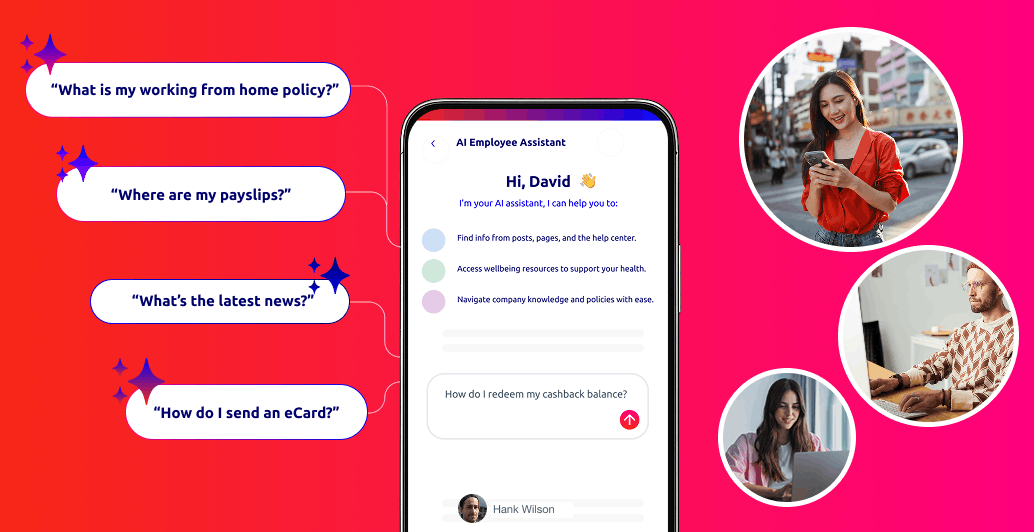
One of the key updates in the Winter Product Update was the introduction of the AI Assistant, a tool designed to provide employees with real-time answers and assistance within the platform.
At its core, the AI Assistant is about reducing friction. Instead of searching through multiple resources, employees can ask a question and get immediate support. The AI Assistant can help employees understand leave policies or how to request time off, and find useful content in the wellbeing centre, such as stretching resources. But the value of an AI Assistant goes well beyond basic search...
Used as part of a broader employee engagement strategy, it can help employees:
-
Understand policies and procedures
-
Find the right information and resources quickly
-
Identify relevant benefits and support options
-
Navigate internal processes with less effort
-
Get help in the moment, without needing to raise a ticket or wait for a response
This kind of instant, self-serve support can be especially valuable in large or distributed organisations, where employees may not always know where to go for answers.
Practical use cases for AI Assistant
The strongest AI tools solve everyday problems. In practice, an AI Assistant can support employees in a number of highly relevant ways.
1. Understanding policies and procedures
Policies and procedures are essential, but they’re not always easy for employees to interpret. Whether someone wants to understand parental leave, how to request annual leave, what to do if they’re unwell, or where to find a workplace process, AI can help simplify access to that information.
Rather than expecting employees to navigate long documents or multiple intranet pages, an AI Assistant can surface the most relevant answer quickly and clearly. This improves the employee experience while helping reduce repetitive questions for HR and People teams.
2. Directing employees to the right person
In many organisations, employees don’t just need information, they need to know who to speak to.
If an AI Assistant understands the organisational chart, it can direct employees to it, or even help them find the right contact based on their question or need. That might mean identifying the right manager, HR contact, team lead, payroll contact, or support owner for a specific issue.
This is a simple but powerful use case. It saves time, reduces confusion, and helps employees feel more confident navigating the organisation, especially in complex businesses or for new starters who may not yet know the right channels.
3. Answering quick roster or schedule questions
Another high-value use case is helping employees with quick questions about their roster or schedule. For frontline or shift-based workforces, this could include simple queries such as:
-
Where can I find my upcoming roster?
-
Who should I contact about a schedule change?
-
How can view or request leave?
This kind of support can make a meaningful difference in day-to-day employee convenience. Rather than switching systems or chasing a manager for an answer, employees can get the information they need quickly and continue with their day.
AI that supports recognition, not just information
Our Winter Product Update also introduced the AI Recognition Coach, another example of how AI can support employee engagement in more human, meaningful ways.
Recognition is one of the most powerful drivers of connection and culture, but giving recognition doesn’t always come easily. Many employees know they want to thank or acknowledge a colleague, but struggle to find the right words.
The AI Recognition Coach is designed to remove that blank-page friction, helping people write recognition messages more confidently and effectively.This can be particualrly impactful for employees who don't speak English as their first language.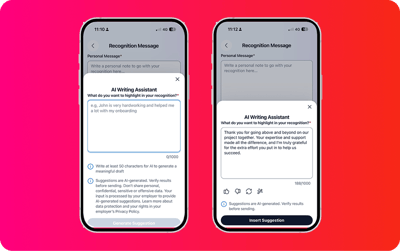
The feature is intended to help employees:
-
Find the right words
-
Improve confidence
-
Overcome language barriers
-
Give recognition more easily and more often
It also includes policy guardrails and is designed to operate in a safe, secure, and private way.
This is an important reminder that AI in employee engagement isn’t only about efficiency. It can also help make workplace culture stronger by making positive behaviours easier to act on.
Better insights for admins through conversational AI
AI also has a major role to play on the administrative side of employee engagement.
As part of the Winter Product Update, we shared the upcoming Insights Bot, an AI-powered assistant that gives administrators information about usage and performance in plain language.
Rather than requiring admin users to manually navigate dashboards or build reports, the bot is designed to answer HR admin questions conversationally and provide instant, contextual answers about program usage and engagement.
The Insights Bot will help administrators:
-
Ask questions in natural language
-
Understand benefits and program usage more easily
-
Benchmark usage within their organisation
-
Analyse engagement survey data for insights
-
Access answers without needing dashboard expertise
This has the potential to make analytics more accessible across a much broader group of stakeholders. Instead of insights being locked behind reporting complexity, AI can help turn data into something immediate, understandable, and actionable.
The role of trust: Privacy, security, and guardrails
Of course, AI for employee engagement only works if employees and organisations can trust it.
That’s why we also highlighted the privacy and security principles behind the AI Assistant. This feature was built with privacy and security front of mind, taking a risk-averse approach to sensitive topics, avoiding the display of personally identified information, and using guardrails to prevent misuse. It also uses segmentation so employees only receive answers relevant to the schemes and segments they belong to.
This matters because trust is foundational to adoption. For AI to be genuinely useful in the workplace, it must deliver relevant answers in a way that feels safe, controlled, and aligned to organisational needs.
AI as an enabler of a better employee experience
AI should not be seen as a replacement for good people practices. Instead, it should be viewed as an enabler, one that helps employees access support more easily, helps managers and teams communicate more effectively, and helps administrators make smarter decisions faster.
Whether it’s answering a quick question about leave, helping someone find the right person in the business, supporting a shift worker with schedule information, improving the quality of recognition, or giving HR teams instant insight into program performance, AI has the potential to remove friction at every stage of the employee experience.
That’s where its real value lies: not in novelty, but in usefulness.
Final thoughts
The next generation of employee engagement will be shaped by experiences that are more connected, more responsive, and more intuitive. AI has an important role to play in that shift.
From AI Assistant and AI Recognition Coach to the Insights Bot, we've showed how AI can support both employees and administrators with faster answers, stronger recognition, and more accessible insights.
For organisations looking to improve employee engagement, streamline support, and create a better overall employee experience, AI is becoming an increasingly practical and pivotal part of this strategy.
If you’d like to explore how AI-powered tools could support your employee engagement strategy, talk to our team about what’s available now, what’s coming next, and how to bring these capabilities to life in your organisation.