Why Millennial managers are an at-risk group at work
Our research found that Older Millennials are the least engaged generation. Learn why Millennial managers are an at-risk group and how organisations and HR leaders can better support them.

.png?width=600&height=401&name=Millennials%20in%20a%20group%20on%20laptop%20(1).png)
Millennial managers sit at the centre of today’s workplace. They are often the people translating strategy into action, supporting team performance, navigating change and shaping culture day to day. They are also increasingly managing teams made up of multiple generations, each with different expectations, communication styles and learning preferences. In many organisations, they are the connective tissue between leadership and the wider workforce.
That's why one finding from Reward Gateway | Edenred’s 2026 Workplace Engagement Index 2026 matters so much: Older Millennials are the least engaged generation in our research.
This is more than an interesting workforce trend. It's a risk signal for Australian and New Zealand businesses. When a cohort with such a strong influence on people, performance, and culture becomes disengaged, the impact can spread quickly. It can affect team morale, productivity, retention, and the overall employee experience. If organisations want to strengthen engagement across a multi-generational workforce, Millennial managers are one of the most important groups to focus on.
We explored this in detail in our recent partner webinar with Go1: One EVP, many generations and the role of millennial managers in making it real. Check out our recap blog below or watch the on-demand session here.
Why Millennial managers matter so much
Millennial managers occupy a uniquely important position in many organisations. Many are experienced enough to hold significant responsibility, but are still close enough to the day-to-day employee experience to shape it directly. They are often responsible for delivering outcomes, managing change, coaching others, and maintaining team energy in environments where resources and time are stretched.
In practice, this means they are expected to balance a great deal. They may be leading teams while also handling individual workloads, responding to senior leadership expectations, and adapting to shifting business priorities. In some cases, they are also supporting employees from different generations, all of whom may need different things from work in order to feel motivated and connected.
Because of this, Millennial managers are not just another employee segment. They are a key lever for organisational success. Their engagement matters not only for their own wellbeing and performance, but for the experience of the people around them.
Our research shows Older Millennials are the least engaged generation
Our 2026 Workplace Engagement Index reveals that Older Millennials are currently the least engaged cohort in the workforce. While workplace engagement appears relatively stable at a high level, the generational breakdown tells a more complex story. Some groups, particularly Gen Z, are more likely to say they feel more engaged at work. Older Millennials, however, are much more likely to report lower engagement.
28% of Older Millennials say they feel less engaged than they did previously, compared with just 18% who say they feel more engaged, and 54% who report no change.
This matters because Older Millennials are often the very group organisations rely on most heavily. They are frequently stepping into senior management responsibilities, leading teams, influencing culture and driving execution. In many businesses, they are the “joy creators” and everyday culture carriers. When this group is struggling, the ripple effect can be significant.
Why this is a business risk, not just a people issue
When manager engagement drops, the impact rarely stays isolated. Managers shape how work feels for everyone else. They influence whether employees feel recognised, supported, and connected to purpose. They help set the emotional tone of the team.
If a Millennial manager is burned out, stretched too thin, or feeling undervalued, it becomes harder for them to create positive experiences for others. Recognition can become inconsistent. Development conversations may fall away. Team morale can dip. Stress can spread. Over time, this can contribute to lower performance, weaker retention and a less compelling Employee Value Proposition.
That is why Millennial managers should be seen as an at-risk group with outsized organisational influence. Supporting them is not simply about helping one generation. It's about protecting the leadership layer that keeps teams functioning well.
What is driving disengagement among Older Millennials?
The story in the data is not just about this hit to engagement. It's also about why.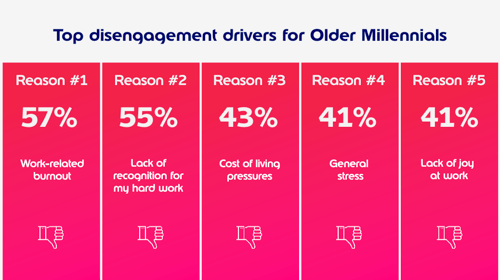
Across the workforce, the leading disengagement drivers are burnout, lack of joy at work, lack of recognition, and stress. Cost pressures also continue to weigh on employees. These issues are particularly relevant for Older Millennials, who are often juggling leadership expectations, growing responsibilities, and pressure to deliver for both their teams and the business.
Burnout is the biggest issue. More than half (57%) of Older Millennials who say they are less engaged cite burnout as a contributing factor. For Millennial managers, that makes sense. This group is often expected to do more with less, support others through change, and remain productive while taking on leadership responsibilities that can be emotionally demanding.
Recognition also remains a major gap. Managers are often expected to give recognition, but many are not consistently receiving it themselves. That creates a difficult dynamic, especially for a group being asked to motivate others while running low on their own reserves.
Unsurprisingly, cost-of-living pressures are acutely felt by Older Millennials, who are often navigating rising interest rates with childcare or school fees, caring for older parents, and ever-escalating grocery bills.
Lack of joy is another important signal. Joy at work is sometimes dismissed as a “nice to have,” but it's closely connected to energy, commitment, and resilience. When work becomes purely transactional or relentlessly pressured, engagement suffers.
The challenge is twofold: Re-engage them and equip them
The findings point to two connected priorities for organisations. The first is to re-engage Millennial managers as employees in their own right. They need support, recognition, wellbeing, and meaningful development opportunities just like any other cohort. If they are carrying too much strain, it will be difficult for them to sustain performance over time.
The second is to equip them to lead effectively across a multi-generational workforce. Many Millennial managers are expected to manage people older and younger than themselves, each with different expectations of leadership, communication, and growth. That requires capability, confidence, and access to the right tools.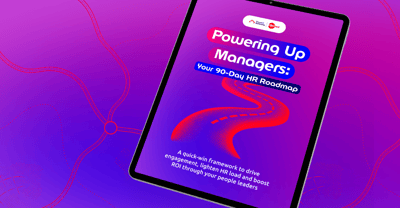
These two priorities are deeply linked. A manager who feels supported is better placed to support others. A manager who feels capable is more likely to create a positive team environment. If organisations only focus on what Millennial managers can do for others, and not what they need themselves, they miss the point.
Want to empower your managers and lighten your HR load? Access our free workbook: Powering Up Managers: Your 90-Day HR Roadmap.
Why a one-size-fits-all EVP no longer works
One of the clearest implications of this research is that a generic EVP is no longer enough. Workforces are too diverse, and the drivers of engagement vary too much by life stage, role, and generation.
A strong EVP still needs a consistent core, but it also needs enough flexibility to feel relevant to different employee groups. That is especially true when one of your most important leadership cohorts is under pressure.
For Millennial managers, that means an EVP should do more than talk broadly about culture or development. It should clearly demonstrate how the organisation supports growth, reduces friction, recognises contributions, and helps managers thrive in demanding roles. If those things are not visible and accessible, the EVP risks feeling disconnected from lived experience.
The role of learning and development in supporting Millennial managers
Learning and development has a critical role to play in making the EVP real for this cohort. It's not just a retention tool or a benefit. It's one of the most practical ways to help Millennial managers feel invested in, build confidence, and navigate the realities of leading others.
But traditional learning approaches often miss the mark. Long courses, generic programs, and clunky delivery methods do not work well for managers who are already time poor.
If development is going to support this group, it needs to be relevant, personalised, and easy to access.
This is where multi-generational learning strategies matter. Different generations tend to prefer different styles of learning, and all employees are dealing with limited time. For Millennial managers, the most effective learning is likely to be practical, timely, and embedded into the flow of work. It should help them solve immediate challenges, whether that's recognising a team member more effectively, managing burnout, leading across generations, or building resilience.
What support should show up more strongly in the EVP?
If Older Millennials are a priority cohort, there are several things that should be more visible in an EVP designed to support them.
First, manager development should be more explicit. Many organisations talk about leadership, but fewer make development truly accessible for managers at the point of need. Support should include clear pathways for building everyday leadership skills, not just high-potential programs for a select few.
Second, recognition should be built in as both a manager capability and a manager experience. Millennial managers need tools that help them recognise others well, but they also need to feel seen for their own efforts. Managers should be supported to give meaningful recognition using clear principles, such as highlighting the action someone took, linking it to a company value and explaining the impact it had. Just as importantly, organisations should ensure recognition flows upward and sideways too, so managers are not left carrying the emotional load of the team without acknowledgment.
Third, wellbeing and burnout prevention should be practical rather than symbolic. This group does not just need messages about balance. They need workload support, clarity on priorities, and access to tools that make work easier.
Finally, the EVP should make learning simple to access. The more friction involved, the less likely busy managers are to use it. Development needs to be visible, relevant, and integrated into everyday platforms and routines. Short, practical learning pathways focused on employee engagement, recognition, resilience, burnout, belonging, and leading across generations can help Millennial managers build confidence without adding to their time burden. When learning is tailored and easy to consume, it's far more likely to be used.
Making support easier to access through technology
Support only works if people can actually access it. That is why technology and employee experience design matter.
When learning, recognition, and other support tools are embedded into a central employee experience platform, it becomes much easier for managers to use them. Instead of switching between multiple systems and logins, they can access what they need in one place. That reduces friction and makes development feel like part of work, rather than an extra task.
Segmentation also gives organisations a more practical way to personalise an EVP. Rather than offering the same experience to everyone, employers can surface targeted content, benefits, and development opportunities for specific groups, such as Millennial managers. This helps employees see support that feels relevant to their role and stage, while still maintaining a consistent organisational culture.
Why this matters for the future of work
As organisations continue to navigate changing expectations, economic pressure, and increasingly complex workforce dynamics, the manager experience will become even more important. Businesses cannot afford to overlook the cohort responsible for translating culture into everyday reality.
Older Millennials are not simply one generation among many. In the majority of organisations, they are the people carrying leadership capability, team energy, and operational momentum. If they are disengaged, the organisation feels it. If they are supported, the organisation benefits.
That is why Millennial managers should be treated as both an at-risk group and a high-impact one.
They need more than broad EVP messaging. They need practical support that helps them feel engaged themselves and capable of leading others well.
Supporting them means looking more closely at what is driving disengagement, including burnout, lack of joy, stress, and limited recognition. It means building an EVP that feels relevant to their reality. And it means making learning and development, recognition, and wellbeing support easy to access in the flow of work.
For organisations serious about engagement, retention, and culture, Millennial managers are one of the most important groups to get right.
Get in touch with our team to explore how our leading employee engagement platform can help you empower your managers, free up HR capacity, and deliver measurable ROI for your people program.