








Key findings from our Workplace Wellbeing Report
Discover the pivotal statistics reshaping employee wellbeing in the UK and gain actionable insights to enhance your workplace strategy

.png)
It's fair to say the landscape of employee wellbeing in the UK has undergone a seismic shift. While wellbeing used to be seen as an additional perk - a "nice to have" but not an essential - the pandemic and subsequent shift in how we work has changed how employees view their health and wellbeing, both inside and outside the workplace.
According to the latest findings from our Workplace Wellbeing Report, 58% of UK employees now prioritise their wellbeing more than they did six months ago. This shift is even more pronounced among younger workers, with 67% of employees aged 16-24 and 68% of those aged 25-34 placing greater emphasis on their wellbeing. These statistics underscore a broader trend: employees are increasingly seeking a holistic approach to their work-life balance, one that allows them to manage their mental, physical, and emotional health more effectively.

Employee wellbeing priorities have shifted post-pandemic
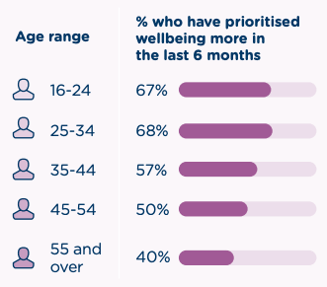 Our report provides a wealth of insights into the current state of employee wellbeing in the UK. Key statistics from our study paint a vivid picture of a workforce that is more conscious of its wellbeing needs than ever before.
- 58% of employees prioritise their wellbeing more now than six months ago.
- 84% would consider staying at a job longer if they had more mental and physical wellbeing offerings.
- 81% say that wellbeing impacts their productivity at work, with 44% stating it significantly impacts their productivity.
- Only 26% of employees feel comfortable talking about their mental health at work.
These numbers highlight a growing expectation among employees for employers to take an active role in supporting their wellbeing. It's not just about offering gym memberships or occasional wellness days; employees are looking for comprehensive wellbeing programmes that address their diverse needs.
Wellbeing is now an expected condition for employees to perform
The link between employee wellbeing and productivity is undeniable. An overwhelming 81% of employees believe that their wellbeing directly impacts their productivity, with 44% stating that poor wellbeing significantly hinders their work performance. This connection is more than just a theory; it's a lived reality for many workers.
When employees are stressed or burned out, their ability to focus, engage, and perform effectively diminishes. This not only affects their individual output but can also have a ripple effect on team morale and overall business performance.
Companies that fail to prioritise employee wellbeing risk not only a decline in productivity but also higher levels of absenteeism and turnover.
There is a direct link between wellbeing and retention
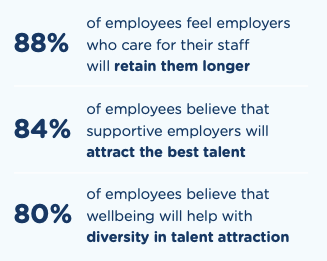
Employee retention is another critical area where wellbeing plays a pivotal role. Our study revealed that 84% of employees would consider staying at a job longer if they had more mental and physical wellbeing offerings. This statistic alone should be a wake-up call for employers.
A supportive work environment that prioritises employee wellbeing can lead to higher levels of job satisfaction and loyalty. When employees feel valued and supported, they are more likely to stay with their current employer, reducing turnover rates and the associated costs of recruitment and training. Moreover, a culture that promotes wellbeing can act as a diversity enabler, attracting a broader and more inclusive talent pool.
4 strategies to make employee wellbeing an HR priority
.png?width=500&height=260&name=2025_The%20Evolution%20of%20Workplace%20Wellbeing_UK-digi_Featured%20Image%202(1).png)
Download our full report, Workplace Wellbeing: A Business Imperative to uncover even more insights, and the steps you need to take to build an employee wellbeing programme fit for the growing priorities of your workforce.
The report will provide you with a 4-step strategy, detailing how to boost the impact of your wellbeing programme and initiatives by:
- Thinking like a marketer
- Conducting a wellbeing audit
- Tailoring your communication
- Building a culture of continuous recognition
Our latest findings underscore the growing importance of employee wellbeing in the UK. By prioritising wellbeing, companies can boost productivity, enhance employee loyalty, and foster a more inclusive and supportive work environment.
Speak to one of our employee experience experts today to discover how we can help you in implementing effective strategies to build resilient, engaged and highly productive workforce.

.jpg?width=406&height=243&name=workplace-toxicity-concept%20(1).jpg)